Egbert Hiller
"...transforming my thoughts into sound..."
about the composer Iris ter Schiphorst
in Raue Zeiten - Neue Musik in/als Reibung (Publications of the Institute for New Music and Music Education,
Darmstadt, Volume 63.) Single issue - Editors:inside: Chirsta Brüstle, Marie-Anne Kohl, Karolin Schmitt-Weidkamp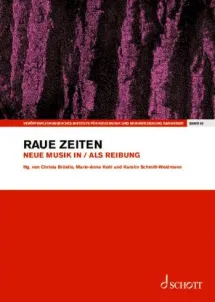
Excerpt
... However, the times have long been rough in her perception, as she emphasised when she was awarded the Heidelberg Women Artists' Prize in 2015:
"What can music do at all in these times, which are so violent and corrupt and characterised by an appalling neoliberalism that rules everywhere, which also sweeps music off the table like nothing good. The utopia that music actually means - listening to it, performing it, taking part in a sound experience that at best even says something - is coming under increasing pressure. But sometimes I also think that our wonderful music, or music in general, perhaps actually says too little. Basically, you should just stand up and speak out a lot more, but then in return I'm occupied with the question of how I can perhaps transform the thoughts I have about it into art, into sound?"
This equally fruitful and gruelling field of tension forces Iris ter Schiphorst to take a stand time and again, even in front of herself: "If I want to say something, and I am able to say it clearly in language, then I should do so, but then I don't need to make music for it."
Nevertheless, she emphasises the intrinsic qualities of music, which defies the communication of specific content or unambiguous messages: "Music is a different medium of expression with its own power and possibilities. What music is about cannot simply be reduced to a common denominator and clearly defined. Sound has its own life and its own capacity for expression, and this life of its own cannot be completely controlled by us composers, even in the creative process itself."
With these words, Iris ter Schiphorst takes up the dichotomy between dimensions of content and abstract design, or, applied to socio-political phenomena, the dichotomy between political statement in the sense of rebellion against prevailing conditions on the one hand and artistic abstraction on the other.
(...)
She is characterised by the fact that she does not allow herself to be pinned down to one genre or one particular aesthetic direction. Her stylistic openness and versatility is a central criterion of her creative identity and is rooted in her early musical experiences.
"I think it plays a role that I came to the piano not so much through sheet music, but rather by ear. My mum was a pianist, so it was natural that I was always fiddling around on the piano at home. I tried to imitate what I heard, and my mum would sometimes say: 'Oh dear, why don't you play something decent'. I internalised the classical works by ear so that I could somehow play them without notes on the keyboard. The love of listening or the pleasure of finding something by ear developed in me incredibly early on. I used to describe myself as an expert in the in-between. I played classical piano with great passion and grew up with this whole tradition. Nevertheless, I also came into contact with many other styles of music through a variety of circumstances and also enjoyed being a musician in them." (ItS)
Iris ter Schiphorst was a bass guitarist, drummer and keyboardist in rock and pop formations, but she found her way to New Music, which was anything but a coincidence. Rather, her wide-ranging interest in current artistic and scientific trends was combined with her deep affinity for music.
"I came to contemporary music via the diversions of philosophy, because when I came to Berlin, actually to write novels, a university seminar put me on the track of intensively studying the post-structuralists. I read a lot of Jacques Derrida, whose texts were still brand new in the 1980s, and at some point the question arose in me: what do people think about music today, or what is music today, what is contemporary music at all?"
Iris ter Schiphorst was also inspired to explore this question by Luigi Nono, whose courses she attended, and Dieter Schnebel. She increasingly focussed on the political and social dimensions of music. These are exemplified in her work Zerstören (Destroy) for ensemble and CD recording from 2005/2006 - including the dichotomy between the immediate need for expression and artistic abstraction.
(...)
However, Iris ter Schiphorst handles the "destruction" factor very sensitively. She only unleashes martial intensity of expression in phases. Instead, she plays subtly with tonal fragilities and states of suspension - as if a supposedly stable system is being hollowed out from the inside until it collapses with a crash. Experimental playing techniques enrich the multi-layered soundscape, which also incorporates the spoken word.
"There are only fragments of text, words that appear, a short text by Marguerite Duras from her novel 'Détruire dit-elle'. I kept thinking about this novel while composing; it revolves around the idea of how a different social order can be achieved. Duras was concerned with the destruction of the symbolic order: in the novel there is an Alissa who tries to change things by being passive and doing nothing, to bring them out of balance. I think that's an exciting approach." ...
In the score, Iris ter Schiphorst noted: "There are three extremely dense parts in -'Zerstören'- which consist of interwoven cross-fades of different layers."[1] She thus anticipated essential aspects of the work's construction principles, whereby its structural identity corresponds closely with the extra-musical concerns. In her commentary on the work, she characterised Zerstören as a "sound protocol of a psychosomatic reaction to the global omnipresence of violence". In any case, the images "that are currently going around the world are quite impressive and I realise that they do something to me, that they change me."
Since the premiere of Zerstören at the Wittener Tage für neue Kammermusik in 2006, the situation of humanity has not improved; on the contrary, times have become even harsher due to the pandemic and the war in Ukraine. The work is therefore not lacking in topicality - and ter Schiphorst is more concerned than ever with the question of what role music can play in a social context. Destroy is situated precisely in this area of tension. The music "says" a lot, but remains ambiguous and abstract.
(...)
For Iris ter Schiphorst, both the musical content and the examination of political and social issues, including their relevance in music, and the pure joy of sound are interdependent, although the relationship between the two spheres is complex and must be constantly redefined:
"I'm very preoccupied with that. When we talk or think about society, politics, etc., we are cognitively occupied with the semantics of language. But in music, at some point this kind of semantics no longer plays a role. Sounds speak to me in a language beyond semantics."
A different perspective is revealed by her piece from childhood lost for electric guitar, prepared piano, sampler, violin, viola, string quartet and two CD players. The piece was created in 2004/2005...In aus kindertagen verloren, the instrumental sounds are amplified throughout and enriched and charged by additional tapes, with children's verses and quotes from novels interspersed, which is also present in another form - with the text by Marguerite Duras - in Zerstören. The instrumentation is unusual and opens up its very own sound potential, which corresponds on a higher level with the motivation for the work:
"For me, this work is about a special energy that is fuelled by curiosity about life, the search for adventure, wildness, being untamed. An energy that doesn't care about rules, obligations, forms. As a child, I loved playing Punch and Judy. With a childhood friend, we invented the craziest stories on the spur of the moment, intoxicated by the characters and the strange voices we gave the puppets - intoxicated by the energy and alertness of the here and now."
Iris ter Schiphorst sought to capture this energy in aus kindertagen verloren, which almost gives this music the character of a self-portrait. In connection with her work Zerstören, two sides of her view of the world appear in the two works, but they are closely related: on the one hand, the flashback to the child's soul, to the lost childhood, which, however, through quotations from the novel Emilia gerät in die Kriegswirren or O der neue Tag by Karin Spielhofer, by no means seems only carefree. On the other hand, the visualisation of a brutal reality that manifests itself in destruction . Dream and reality, utopia and the present interpenetrate and form a striking pair of opposites in their juxtaposition.
Iris ter Schiphorst then found a form of synthesis between dream and reality in her short opera Undine geht, a kind of monodrama based on the text of the same name by Ingeborg Bachmann for an actress, a singing cellist, a singer, mixed ensemble and interludes, composed in 2020/2021 for the 2021 Salzburg Pocket Opera Festival. She wrote the libretto herself, based on the text by Ingeborg Bachmann. ...
Two texts served as starting points for creative reflections on Undine as part of the pocket opera festival: Friedrich de la Motte Fouqué's Undine from 1811 and Ingeborg Bachmann's Undine geht from 1961. Iris ter Schiphorst focussed on Bachmann's text, which she herself suggested to director Thierry Bruehl for inclusion in the theme and which she examined for its relevance to the present and future in her pocket opera of the same name.
"For me, the focus was on once again working through the utopias that resonate in Bachmann's text and which are also partly ambiguous for me. The opera begins like a fairytale, with overtone martellato singing and a cello twittering, which opens up a space that leaves everything open, including the possibility of a fairytale opera."
The mysterious mood from the beginning quickly turns into harsh bitterness, quirky charm and piercing sharpness. Shrill revue echoes merge with equally reflexive and politicised observations on the relationship between the sexes, and highlights from the operatic tradition collide with sound fragments from pop culture, which also symbolise an incursion of the subculture into the sphere of so-called high culture.subculture into the sphere of so-called high culture - which refers back to Iris ter Schiphorst's connections to pop culture, to "the smoky clubs and practice cellars".
In her short opera, Undine is divided into a creature of nature and a woman of today who makes her grand entrance as a speaking Undine - as a woman who speaks out. The contrast outlined above between the concrete verbalisation on the one hand and musical abstraction on the other is resolved here. The two are juxtaposed, whereby it was important to Iris ter Schiphorst to unroll the story of Bachmann's Undine from the back, because the character speaks text, which in Bachmann's Undine comes at the very end: "The world is still dark"; even 60 years after her text was written, there is still no clearing in sight.
Iris ter Schiphorst's'Undine geht' incorporates operatic tradition and pop culture, elements from spoken theatre and a highly virtuoso solo cellist who also embodies the character of Hans from Bachmann's text. The work also places special demands on the ensemble, including samplers and electronics, which sometimes go far beyond conventional interpretation by crossing the boundaries into singing, screaming or whispering. ...
The "curiosity about life", which was a lost theme from childhood, also applies to Undine geht. It is embodied in the figure of Undine herself, who, as a creature of nature, encounters people with precisely this curiosity, but must fail because of them - mindful of a state of the world in which little has fundamentally changed in terms of power relations in the 60 years since Ingeborg Bachmann's text of the same name - although from a feminist point of view, which is also an essential one for Iris ter Schiphorst, a lot has happened.
The short opera Undine geht points to a fairytale world that is, however, broken and clashes harshly with reality. In this work too, rebellion and abstraction intertwine, but in a very specific, namely surprisingly concrete way, especially as far as the acting of the text is concerned - although the language, which is itself sound, also functions as a purely sonic layer. The work remains multi-layered and ambiguous in its complexity and the interpenetration of different levels, in the way Iris ter Schiphorst transforms her thoughts into sound. And the interlocking of supposedly opposing spheres can be seen as a structural roughness in the large-scale formal conception.
The questioning of the mythical Undine leads to the realisation that the world of nature and fairy tales is finally passé, that it is only suitable as an imaginary retreat, as a dream structure - because escaping to promising (natural) paradises has become virtually impossible: Everything has been developed and economised, much has already been destroyed. Undine leaves, she has to leave, leaving behind the harsh reality that has become even harsher since this short opera was written two years ago in 2021. On behalf of the composer herself, but also for the recipients of her music, dreams and hopes seem to be shattered, but not quite - a remnant of utopia remains, even for Undine, who, as the embodiment of utopia, is heading towards harsh times.
________
The quotes are taken from conversations between the composer and author in 2015 and 2021