AUNG (2010/2011)
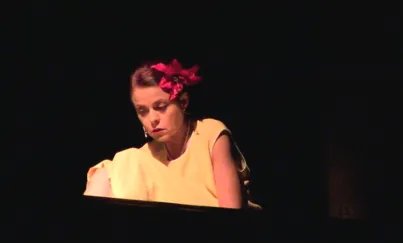
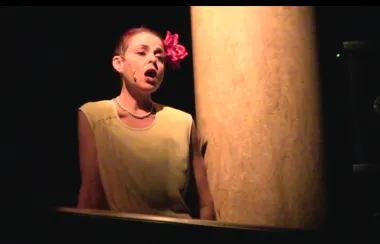
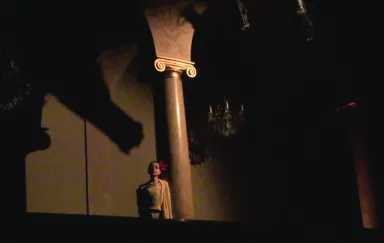
for staged singer/performer, ensemble and live electronics
Text: Helga Utz
Duration: 25 min.
Commissioned by BIT 20 (Norway) and Integra/Birmingham in co-operation with NOTAM (Norway)
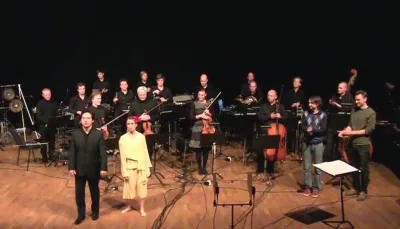
WP: 01.10.2011, The Royal Danish Academy of Music, Studio Hall, KopenhagenAnna Clementi / BIT 20 / Baldur Brönnigmann,
Programming of the live electronics: Dag Henning Kalvoy
Performance material available from Boosey & Hawkes
exact instrumentation:
1.1.1.1-1.1.1.0-perc(2)-harp-pft-strings-electronics
AUNG, a kind of concertante chamber opera about the life and motives of opposition leader AUNG San Suu Kyi, who is under house arrest, is the second joint project by composer Iris ter Schiphorst and librettist and director Helga Utz. (Their first joint project, the children's opera "Die Gänsemagd", was premiered two years ago with great success in the Vienna Jungle as a production of the Taschenoper and has since had numerous revivals).
AUNG will be performed by singer-performer Anna Clementi, who has already premiered numerous works by Iris ter Schiphorst, including the 3D opera Annas Wake, the chamber opera Euridice and the multimedia music theatre Silence Moves (winner of the BLAUE BRÜCKE composition competition in 1997). From the early 1990s, she was a member of intrors, an ensemble founded by Iris ter Schiphorst, which mainly performed electro-acoustic compositions.
Current political background (2011)
The conditions under the military government in Burma (Myanmar) are inhumane.
Human rights violations such as forced labour, forced eviction from villages, torture, rape and the use of child soldiers as well as arbitrary arrests and mistreatment of prisoners are commonplace. Despite abundant natural resources, the population is very poor. More than half of the national budget is spent on the military, secret services and police.
Due to the catastrophic situation, the International Committee of the Red Cross has publicly accused the government of serious human rights violations.
The best-known opposition leaders are the comedian Zarganar, who has been banned from working and is currently in prison, and Aung San Suu Kyi, who has been under house arrest for many years.
Historical background
Aung San Suu Kyi's father, General Aung San, successfully fought for Burma's independence from British colonial rule, but was assassinated shortly before achieving his goal. He would have been Burma's first elected president and wanted to establish democracy in Burma. For AUNG, he is therefore a great role model and represents a possible world without violence. However, the current junta sees him as a representative of its own interests and therefore refers to him as "father", as he had fought for an independent Burma and against the British and Japanese. Both sides use his memory for their own ends. The fact that AUNG did not fall victim to an assassination attempt by the military junta long ago has to do with the high esteem in which her father is held by the military junta due to his historical merits.
Aung San Suu Kyi received her formal education in India, where her mother, who always honoured the memory of Aung San Suu Kyi's father, worked as Burma's first female ambassador. There, Aung San Suu Kyi attended the best schools and became friends with Indira Gandhi and her sons Rajiv and Sanjay. She first studied political science in Delhi and later philosophy, political science and economics at Oxford. She worked at the United Nations in New York and with her husband Michael Aris, a Tibetan scholar, in Bhutan. The couple have two sons. While Aung San Suu Kyi was teaching and researching in Kyoto and India - including on recent Burmese history and her father's role in it - Burma was cut off from the rest of the world under the brutal dictator Ne Win.
Aung San Suu Kyi's life changed completely when she returned to her terminally ill mother in Burma in 1988 - in the midst of political unrest: people were demonstrating on the streets in favour of democratic reforms. Burma's "second struggle for independence" (Aung San Suu Kyi) began. As her father's daughter, the civil rights activist could not, as she said, stand by indifferently, became politically involved and soon became a symbolic figure. Despite threats of armed violence and a ban on public gatherings, she travelled the country as part of an election campaign for the National League for Democracy (NLD), of which she was a co-founder, and fearlessly advocated civil disobedience. However, the regime ignored her magnificent election victory in spring 1990 and arrested, tortured and killed numerous members of the opposition; Aung San Suu Kyi was placed under house arrest. But she did not allow herself to be silenced so easily. With a ten-day hunger strike, she won the assurance that her fellow campaigners would be treated well in prison. In July 1990, the European Parliament awarded her the Sakharov Prize for Freedom of Thought, a year later she received the Nobel Peace Prize "for her non-violent struggle for democracy and human rights" - the world became aware of her fate - and that of her country. After six years, her imprisonment was suspended for the first time under strict conditions and she was able to receive foreign journalists. Two years later, she was again remanded in custody, which lasted until November last year. She left her two sons behind as adolescents and never saw her husband again, who died of cancer in London in 1999.
see also https://integra.io/portfolio-items/iris-ter-schiphorst/