Ballade für einen Bulldozer (Ballad for a bulldozer) (1990)
for violin (amplified) and synthesiser/sampler
in memoriam Robert von Lieben (1878-1913), the inventor of electron and amplifier tubes
Duration: 9 min.
ensemble intrors, Susanne Schulz - electric violin, Iris ter Schiphorst - synthesiser/sampler
Performance material available from Boosey & Hawkes
From the programme:
In the late 1980s, I ran a workshop at the beautiful Swiss spa hotel ‘Val Sinestra’. One morning, a terrible noise echoed through the entire valley: a bulldozer had started work. Without further ado, I recorded the sound using my Sony Professional. From this, I created a ‘bulldozer programme’ on my sampler at the time (a Casio with 2 MB!) and composed a duet for violin and bulldozer and synthesiser sounds.
The concert set-up for the original version consisted of 1 Casio keyboard sampler with a hold pedal, a Roland D-50 synthesiser with a volume pedal, whose keyboards I had arranged one above the other on a keyboard stand, a 16-channel mixing desk into which the 8 outputs of the Casio, the two from the synthesiser, and the amplified violin, as well as a Yamaha SPX-90 effects unit, which I had programmed with a long reverb.
Current technical set-up:
a PA system appropriate to the venue with at least two L/R speakers (possibly an additional centre speaker),
a monitor speaker for the keyboard,
a mixing desk with approx. 5 inputs,
a clip microphone for the violin, possibly a reverb effect for the violin,
a sample keyboard, a synthesiser keyboard, each with a volume pedal if required.
The samples are in 16-bit, 44.1 kHz format and can be set up for any standard sampler. The exact programming can be found in the score. The sounds for
the synthesiser are also described in the score.
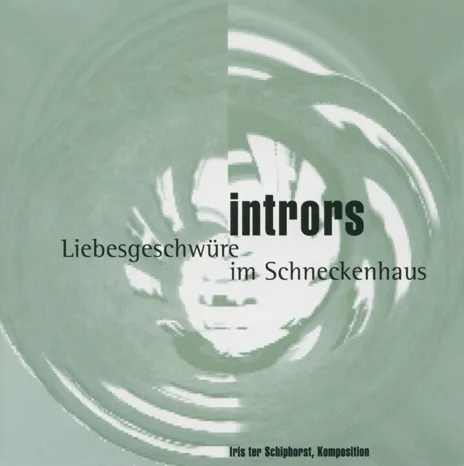
CD Liebesgeschwüre im Schneckenhaus – electroacoustic compositions by Iris ter Schiphorst
Ensemble intrors: Gisburg Smialek – voice/flute, Susanne Schulz, Barbara Buchberger – violins, Iris ter Schiphorst – synthesiser/sampler at SO-36, prod. 1992
Audio: YouTube
About my working method:
First, I set out in search of sound material that inspires me, that sets something in motion within me. It is a phase of gathering (i.e. storing) and experimenting.
This is followed by a more ‘receptive’ phase, in which I try to follow the movement that the sound elements create within me: that is, I strive to discern which combination the selected sound elements demand. Often, a very specific concept for a piece emerges in this way; sometimes, however, it remains simply a desire to explore the material again and again in new and different ways.
The selection of the performers, i.e. their instruments, follows the same process. Occasionally, the material calls for the specific timbre of a particular instrument and a particular way of playing it. Sometimes, however, it remains merely a vague inkling of a possible encounter... (ItS, 1990)
Reviews
Homa musica by Eckhard Smialek, 6 February 1991
Iris ter Schiphorst, all-electronic composer, plays music of subterranean beauty. She is an academic angel, Brahms and Brahma in the classical underground.
Her sound magic is cool-psychedelic: blonde music for dramatic listeners.
She is a hypervirtuoso keyboardist.She does hand and foot experiments with an enthusiasm for things that definitely work.
She plays to the earth.Venus rises from the lost violin of a violinist...
You will hear...
A little high-tech night music. NWZ, No. 108, 11.05.1991, Susanne Olbrich
...An astonishing number of people turned up for the night concert with the two musicians Iris ter Schiphorst (synthesiser, sampler) and Susanne Schulz (violin) ... and were enthusiastic about this peculiar serenade.
The material of the compositions, all by Iris ter Schiphorst, consisted of electrically amplified and/or processed sounds that corresponded with the electrically amplified violin.The pieces bore titles such as "Ballad for a Bulldozer" or "...ergo sum-'pf'-maschinerie" and, although constructed with the utmost precision, had the effect of meticulous noise collages, an experimental "film music without film".
In the concentrated interplay between the two musicians, sensitively supported by a light show, "the desire to explore the material again and again in new and different ways" was clearly audible and perceptible. Although electronic sounds always have something abstract and incorporeal about them, these compositions did not exhaust themselves in surreal sound aestheticism or high-tech gimmicks. Behind them, a strong, even playful will to express emerged, to sound out levels that cannot be grasped with words...