Bernada Albas Haus (1999) (with Helmut Oehring)
for 7 dancers, 1 deaf performer, 1 soprano, prep. piano/sample keyboard, 1 electric guitar, 1 double bass and live electronics
Music for dance theatre after F. Garcia Lorca
Duration: 90 min.
Commissioned by the Basel Theatre in cooperation with the Hebbel Theatre Berlin and the Fondazine ROMAEUROPA (with the support of the Goethe-Institut)
WP: 11.11.1999, Theater BaselArno Raunig - soprano/Christina Schönfeld - deaf performer/Jörg Wilkendorf - E-git./Peter Kowald - double bass/Markus Reschtnewki - prep. piano/sampler, dancers - Basel-Theatre / choreography: Joachim Schlömer
Performance material available from Boosey & Hawkes
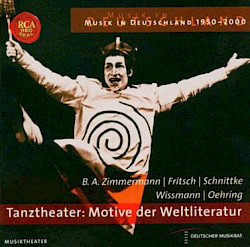
CD Deutscher Musikrat – Musik in Deutschland 1950–2000
Tanztheater / Motive der Weltliteratur,
darauf ‚Bernada Albas Haus’
Arno Raunig / Christina Schönfeld / Jörg Wilkendorf / Peter Kowald / Markus Reschtnewki u.a.
BMG 74321 73577 2
Summary
"... Federico García Lorca's story of old Bernarda and her daughters is retold with the means of dance theatre. It is not primarily the Spanish village tragedy that is of interest here, but rather the effects and principles of prohibitions and taboos. What is life like for seven women in a house where the subject of sexuality is taboo? The music gives this "tragedy" a musical space in which this oppressive "atmosphere of silence" is made most impressively visible through the compositional condensation of electronically alienated sounds."
Excerpts to listen to: YouTube
Reviews
FAZ, 19.11.1999, Jochen Schmidt
"The Basel Bernarda team goes further in its abstraction than all others who have attempted to translate the play into dance. The fable is only of interest here insofar as it creates the atmosphere of hysteria that Schlömer and Oehring are after: a steam boiler of suppressed passions, in danger of exploding almost from the start.
The music is more actively involved in creating this atmosphere than in most other dance pieces...an unconventional music of melodically interspersed noises: Vocal cantilenas soaring over clusters, nervous sawing of the double bass, electronic explosions behind which, almost inaudibly, Schubert's Ave Maria or the distant song of a muezzin unfolds.
Schlömer's choreography condenses the musical instructions into a dark maelstrom that sweeps the audience along inexorably. For five quarters of an hour, the performance drills almost painfully into the audience's nerve centre."
Positions February 2000, Gisela Nauck
"Three like-minded, like-feeling people obviously came together with the authors, because it became a dance theatre piece "as if from a single mould". Helmut Oehring and Iris ter Schiphorst developed a tonal score that moves between the extremes of a slow-motion standstill and musical torpor in glaring noise. Monotonous repetitions, breaks, new beginnings of the same, loops, occasional sounds "from outside" (bells, a bird) and repeated fragments of Bach and Schubert - memories of the past, of an ideal world, longing, drowned in the noise of an ancient gramophone. Oehring and ter Schiphorst have added an unconventional pair to the Lorca figures. Its function is similar to that of the Evangelist in Bach's Passions, but in fact it embodies the untold nature of a story, because its reality plays out in the emotions: the deaf performer Christina Schönfeld, who narrates the main features of the fate of Bernarda Alba and her daughters in sign language, to which the countertenor Arno Raunig - whose text is naturally just as difficult to understand in cantilena singing - gives expression in the literal sense. Throughout the piece, the pair are strangely at odds with each other - musically too - because they actually do what one expects but ultimately cannot understand.
Equipped with this ready-made score, Joachim Schlömer created a choreography of realistic symbolism for the Tanztheater Basel ensemble in the (stage and costume non-)colours black and white - and occasionally red (Frank Leimbach, Gesine Völlm). A deadly flamenco is the only "real" dance in it. Just as in the music, the dance language is dominated by discontinuities, fragments: as disruption, aimless activism, fruitless outbursts. Only Bernarda Alba represents frightening consistency with her slow gaits and movements. In these premieres and first performances, music and dance merge into a black emotional theatre of gestures, movement and sound, uncompromising, without embellishment, brutal - but touching. The dancers of the Tanztheater Basel and the instrumentalists Peter Kowald (double bass), Markus Retschnefki (prepared piano, keyboard) and Jörg Wilkendorf (electric guitar) provided the necessary dance and acoustic presence. And I finally had a seat in the Hebbel Theatre so that I could experience the necessity of Dolby surround sound (Torsten Ottersberg) for myself."