Breaking (2012)
for amplified ensemble, sampler and live electronics
Duration: 15 min.
Composition commissioned by the Ensemble Mosaik
WP: 13.12.2012, Berghain/BerlinEnsemble Mosaik, Enno Poppe
Performance material available from Boosey & Hawkes
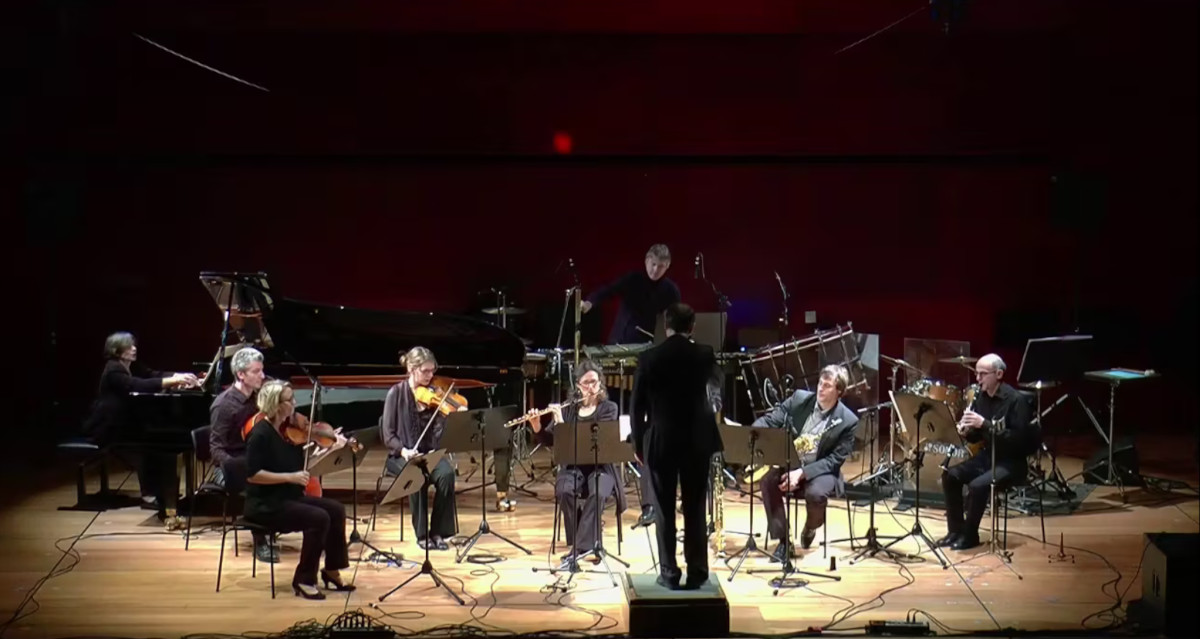
exact instrumentation:
fl.ob(=corA).cl.ssax(=bsax)-perc-pft(=kbd)-vln.vla.vlc; sampler
Programme text
'Breaking' (for amplified ensemble, sampler and live electronics) refers, among other things, to the film 'Breaking the waves' by Lars von Trier. The temporal progression of the piece corresponds proportionally to that of the film, which is indicated on the 'story-line' in the score. Some of the changes of location in the film are marked accordingly in time changes and also assigned to certain instrument combinations or sound files.
However, there is also another level of sound: the entire piece is framed by 'dark' sounds projected onto all the walls of the Berghain, which enclose the musicians and audience like a vault of sound. This second sound level creates a kind of 'cave situation'.
Media philosophers describe the cave as a place of retreat on the one hand and of ("lying") narrative, fantasy and memory on the other. Caves are therefore places of regression and fascination and the question is always how and whether one will come out again at some point (or even want to come out at all).
Orpheus tried, but ultimately failed, as does all music when it wants to free itself from its own evolution / its own cave ground and, for example, tell stories about - for example - man.
This tends to happen in the cinema, possibly the most popular cave location. For example in the film 'Breaking the waves', in which all the protagonists actually want what is good, but don't know what they are doing (also great cinema): fulfilling the wishes of others. In the film, this is called love.
René Girard calls it 'mimetic desire' and that never works without sacrifice, or rather or 'over her dead body' as Elisabeth Bronfen once wrote, even if she couldn't have known Bess from 'Breaking the waves', who in the end will lose her life in a cruel way, a victim (how remarkable) who is only a fictitious victim.rdly that only a f separates the victim from the opera), which the good Lord seems to accept when he allows her to ascend to heaven at the end (freed from her burial cave by Jan) (oh, those bells!), and at the same time ensures that he can rise again from his own hell, from the prison of his body cave.
But that's a story. Not music.
Iris ter Schiphorst, Nov. 2012