Dead Wire. Psychotechnics of Keyboards/a dissociative fugue (2011)
for solo piano, sampler and live electronics
Duration: 16 min.
Commissioned by the Eclat Festival Stuttgart 2012
WP: February 2012, Theatre House Stuttgart, Festival éclatChristoph Grund, Experimental-Studio Freiburg
Performance material available from Boosey & Hawkes
Setting:
Concert grand piano, 2 keyboards on top:
MIDI keyboard 88 keys, MIDI keyboard approx. 44 keys,
sustain pedal, volume pedal
MacBook with interface (8IO)
Max5/msp and Lexicon PCM reverb licences
2.TFT monitor for pianists
Video extension
AKAI sampler
3 microphones, 6 loudspeakers
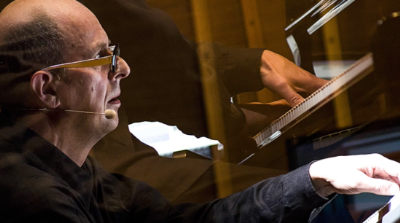
In this piece, the player is pianist, keyboardist, trigger of the live electronics and the samples at the same time, in short: 'master of all keys and effects'. This means that in addition to the 'usual' piano keys, he has two other keyboards to operate, one to trigger the samples, the other to control the live electronics. With the latter, I was interested at the time in recreating a way of playing that is not actually possible with the piano (the fortepiano), namely influencing the sound by pressing keys. With clavichords (a forerunner of the fortepiano) this was possible to a certain extent (keyword: quivering). The live electronics (the patch) are therefore designed in such a way that the pianist can change the sound of the piano by simultaneously pressing keys on the corresponding keyboard in the microtonal range. Delicate, tiny glissandi are just as possible as the typical clavichord 'tremble' and microtonal, virtually stepless up and down movements. In addition, the pianist can make the transformed piano sound louder with the help of a volume pedal (and generate feedback depending on the room), as well as record his own playing in real time with the help of a sustain pedal and play it back at a later time by pressing a button forwards or backwards. In this setting, he is thus the player of a 'hyper-piano', on which his history and the historicity of the various keyboards are inscribed. This not only requires a completely different pianistic way of thinking, but is ultimately a deliberately composed excessive demand on the pianist, which results in every performance being 'different'.
DEAD WIRE Programme text by Reiner Pöllmann for the 2013 Berlin performance at Ultraschall
Dislocations is the title of a piano concerto by Iris ter Schiphorst, which was performed two years ago at the Ultraschall festival by Christoph Grund and the Rundfunk-Sinfonieorchester Berlin under the direction of Peter Rundei. An energetic work that >dislocates< musical particles of very different provenance, i.e. places them in a new, unfamiliar context. Some excerpts from this performance - which was an outstanding success at the International Rostrum of Composers and was broadcast in more than 30 countries - have now been >dislocated< for their part.
Iris ter Schiphorst used them for another piano piece, dead wire, which she also wrote for the pianist Christoph Grund and which was premiered at the ECLAT Festival in February 2012, although >piano piece< is an inadequate term for a work that bears the subtitle >Psychotechnics for keyboard<, which is as unusual as it is promising. And the >pianist< is by no means only active on one instrument, he plays two other keyboards in addition to the concert grand, with which he controls the samples and the live electronics. A piece in which Christoph Grund's multitasking skills are put to the test to a high degree. "Although the live electronic events during the performance are controlled by the pianist himself, these live electronics were developed in the SWR experimental studio. The aim was to use electronic means to make possible what is technically impossible with a modern concert grand piano (in contrast to the clavichord), namely to influence the sound and pitch by pressing the keys. Microtonal glissandi can now be achieved with the help of live electronics. But live electronics don't just work in the micro range of the individual note. Entire passages can be recorded and later played back forwards or backwards. This is probably one of the reasons for the subtitle of the work, which Iris ter Schiphorst calls a >dissociative fugue<. The pianist is in a highly complex dialogue with himself, he is acting and reacting in unison and often at the same time, which is more strongly interlaced by deliberately generated feedback.
Dislocations was already a powerful, stirring and rugged work. In dead wire, the energy level is significantly increased once again, the entire musical action is concentrated on the one soloist, who no longer has an orchestra to play with, but is left entirely to his own devices. dead wire is a highly virtuosic piece that is by no means just a manual challenge for the performer. The "master of all keys" can be heard, but also seen, in a heroic struggle that repeatedly drives him to vocal expressions. In this respect, "Psychotechnics" is certainly an apt subtitle. However, the title itself, dead wire, seems like a deliberate misdirection in view of the necessary high tension.
Reviews
Reviews of the premiere:
Stuttgarter Nachrichten from 14. 2. 2012
Christoph Grund's interpretation of Iris ter Schiphorst's "Dead wire", in which the pianist not only has to play the grand piano, but also operate a keyboard and keep an eye on the screen and notes, was nothing short of spectacular. The bowing of the grand piano strings set the electronic life in motion, virtuoso scales set rhythmic-metric developments in motion like a steam locomotive, high note repetitions were juxtaposed with explosive thunderstorms and their reverberations. And all this was sometimes accompanied by the musician's screams. Furious!
Südkurier
...In the other concerts of the festival weekend, the piano as an instrument steeped in tradition and the human voice formed the common threads, whose potential was, as expected, explored in very different ways by the composers. The piano piece "réfractions" by Madeleine Ruggli (interpreted by Florian Hölscher) was full of poetry and distinctive sounds. Iris ter Schiphorst's "dead wire" for piano and electronics, a stirring piece of bruitism that Christoph Grund put down on the keys and in the sound-modelling keyboard with tremendous force, screaming his heart out. The audience was thrilled ...
NMZ Gerd Rohde
...Iris ter Schiphorst took a more energetic approach in her "dead wire" for piano and electronics. In addition to the piano, the pianist has to play two keyboards, one of which controls the electronics. The tonal expansion between "the most delicate glissandi" (Schiphorst) and powerful sound eruptions is impressive. Changing the keyboard tone by holding down the keys also enriches the colour of the sound. Of course, Iris ter Schiphorst is also and above all interested in the technical process. But her "dead wire" is also an interesting, powerful piece of music.