Dislokationen II (Dislocations II) (2010)
for violin, viola, violoncello, piano/sampler
Duration: 25 min.
Commission from the Trio Coriolis
WP: Nov. 2010, Munich, HörBlicke 21trio coriolis, Christoph Grund
Performance material available from Boosey & Hawkes
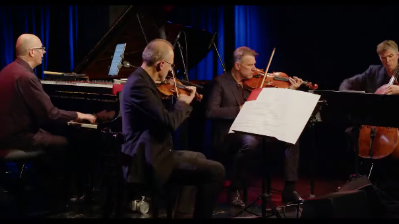
Dislokationen-2, Trio Coriolis + Christoph Grund, live im BKA in der Reihe Unerhörte Musik am 15.11.2022
Programme notes:
The term ‘dislocations’ refers to changes in position or shifts. The term is used in a wide variety of contexts: in geology, it describes the disrupted layering of rock; in military affairs, the deployment of units; in medicine, the pathological displacement of organs or bones; and in linguistics, a marked word order.
In Dislokationen II, the transitions are at times abrupt and surprising, the cuts sudden. Occasionally, elements of popular music flash through, repeatedly creating the impression that something is ‘out of place’.
The pianist constantly switches between the keyboards of the grand piano and the keyboard. Furthermore, the score calls for actions inside the grand piano – at the end of the piece, the performer must even sing. The samples consist partly of recordings from inside the piano, and partly of so-called ‘found sounds’ – that is, sounds found by chance in everyday life.
The work was inspired by Elfriede Jelinek’s novel Lust. A key feature was the montage of everyday language and Hölderlin quotations, which mutate into the grotesque through minimal word twists or rearrangements.
Reviews
Klaus Kalchschmid wrote about the premiere:
During Nicolaus A. Huber's piano trio from 2006, one is still somewhat distracted, as the rain drums on the roofs of the Lothringer13 exhibition rooms and the various videos by Anna Witt, which can be interpreted in many ways, continue to play in all possible corners. But this interaction is part of the programme of "HörBlicke21", which, not without reason, is inviting visitors to look and listen for the third time under this title. So the interplay of sharp-edged, aggressive progressions and sudden delicacy is sometimes only perceptible as ONE parameter alongside other acoustic and visual stimuli in Huber's work.
This will change with Ludwig van Beethoven's third string trio from opus 9, because the undivided attention that the 26-year-old composer demands has also been taken up by the "Trio Coriolis". Michaela Buchholz (violin), Klaus-Peter Werani (viola) and Hanno Simons (cello) demonstrate an intensity and clarity of diction and interplay that concentrates the listener on the sounding event in every bar, in every phrase.
This kind of inner concentration turns the evening's premiere, Iris ter Schiphorst's "dislokationen-2" - again with Christoph Grund on the piano, who now also "operates" a sampling keyboard - into an event: "Dislocation", meaning in various contexts folding, warping, shifting, displacement, goes back to the Latin "dislocare" and can be heard again and again from the music. It begins in an extremely energetic way, moving from upright or horizontal sounds to subtle dialogue. Gradually, it reaches an enormous intensity again, which leads almost abruptly into a scherzo section. Several times the whole thing sounds like an overpainting of already familiar material, Leoš Janácek shimmers through, various playing techniques such as glassy harmonics or, in contrast, a brute martellato on the bridge create the most diverse associations until the piece becomes increasingly pure and purist. And at the end, as is so often the case with world premières, you wish you could hear this exciting piece again in such an excellent interpretation!