Effi Briest (2000) (with Helmut Oehring)
Music theatre psychogram in 4 acts
for 2 voices, 1 male soprano, 1 deaf performer, 18 instruments, live electronics
Libretto: Iris ter Schiphorst + Helmut Oehring
Duration: 90 min.
Commissioned by the Theatre of the Federal City of Bonn
WP: 2001, BonnChristina Schönfeld - sign language soloist, Ingrid Caven - voice, Salome Kammer - voice, Arno Raunig - soprano, Jens Seidenpfad - accordion, Jörg Wilkendorf - electric guitar, Daniel Göritz - electric bass, Ensemble der musikFabrik Nordrhein -Westfalen; conductor: Wolfgang Ott,
Director and set: Ulrike Ottinger; Costumes: Gisela Storch-Pestalozza
exact instrumentation:
solo trp-3cl-2tpt-perc(2)-acc-pft(=sampler kbd)-elec.gtr-elec.bass gtr-2vlc.3db-live electronics
Performance material available from Boosey & Hawkes
exact instrumentation:
1 vocal soloist, 2 female voices, 1 male soprano, clear in Bb, bass clear in Bb, double bass clear in Bb, 2 trumpets in Bb, 3 trombones, electric guitar, electric bass, sample keyboard, piano, 2 percussion instruments, 2 cellos, 3 double basses, additional parts and electronics.
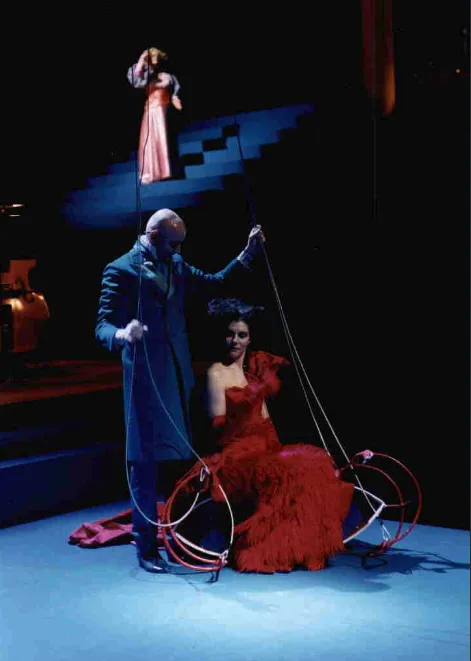
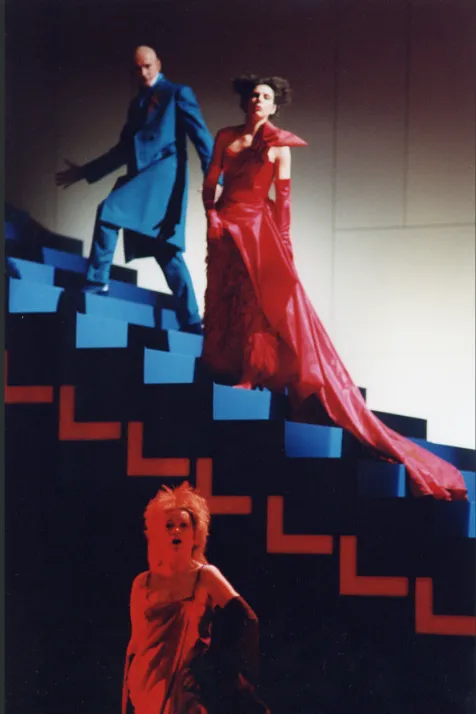
Synopsis
When a composer who thematises communication and language in his works brings Fontane's Effi Briest to the stage with an artist known for her multimedia operas, the tension between interpretation and deconstruction is inevitable. It is almost surprising that the work follows the narrative course of the literary model almost seamlessly. Consequently, both composers have always harboured a deep mistrust of language's claim to establish communication between people. Here, it is more about the possibilities and the prevention of communication; sound, language, gesture, movement and image intertwine and bypass each other. The complex web of changing levels allows the deep psychological subtext of the conflict between desire and convention to shine through, whereby the allocation of voice, figure and performer is deliberately ambiguous. The music expresses the entanglements of language in traditional forms of expression: The fateful, tragic dimension of the events is measured in a range from chanson to baroque aria.
Effi Briest Opera by Iris ter Schiphorst and Helmut Oehring
Production and stage: Ulrike Ottinger
Iris ter Schiphorst and Helmut Oehring's opera Effi Briest is composed according to the principle of parallel montage. This form makes it possible to juxtapose all the actions, feelings and expressions, including being trapped in social conventions, without initially linking them together. In this way, Fontane's characters - who still act within a common value system despite their different life plans - are radically separated from one another. They circle in their own orbits and every contact means collision.
It is precisely this constellation that interests me. The stage is modelled on the aristocratic, upper middle-class houses of the time with their numerous internal and external staircases. This architecture was entirely geared towards the great importance of the "Visits" and provided visitors with theatrically effective performances. The protagonists of the opera are exposed as if on a catwalk and move on a platform in which the strong colours red and blue fight with each other. As in the old viraged films, the colours stand for day and night, love and passion, cold and death. As the music is at the centre of the production, I have placed the orchestra as a visible actor in the middle of the stage. The characters are cast with four very different singer personalities, whose individual and unique abilities are given space in both the music and the performance. Their acting is not characterised by psychological motivations, but by a dramaturgy that structurally brings the conflicts to the surface.
With her spectacular range, Salome Kammer brings a voice into play that masters even the most difficult parts with extreme precision. She is not only able to embody the most contradictory characters, but her voice itself becomes the perfect instrument of collision. Arno Raunig is one of the very few sopranos in the world. With his much-acclaimed, clear-as-a-bell voice, with which he can switch brilliantly between baroque opera and experimental music, he articulates even the most delicate emotions of his multi-faceted stage characters. Christina Schönfeld is a deaf sign language soloist. She takes language back to the basis of its symbolic nature. She is the graphic element. She writes her pictograms in the air, sometimes wistfully and tenderly, sometimes with strict contours. Finally, Ingrid Caven is one of the most unconventional and intellectual European chanson singers. With her sharp wit and melancholy vulnerability, she is the perfect incarnation on stage of all those fragile characters who know about their inner turmoil and yet live it to the full. The staging of the four protagonists thus sets the scene for a dramaturgy of voices, speech and gestures that is just as multi-layered as the complex dramaturgy of colour, space and light. Together they form the aesthetic equivalent of experimental music that is based not only on harmonies but also on discontinuities.
Extract from: Ulrike Ottinger, Parallel Texts
Reviews
NZfM, 3/2001, Frank Kämpfer
"The famous story of the aristocratic daughter who is married off and has a lover is a recurring theme in the Briest family circle. Hardly by chance, the opening scene already makes it clear that the daughter is to marry her mother's former admirer, Ministerial Councillor von Instetten, in order to climb the social ladder. Both their hopes fail, the mother falls, Instetten rises, Effi dies of lack of love. A female fate is thus passed on.
In order to tell this story with greater universality, the two authors deliberately separate the role and the text. At the same time, both Iris ter Shiphorst, who comes from multimedia works, and Helmut Oehring, who thematises communication problems, are largely committed to the linear, narrative process. Fontane's original text is no longer narrated from the distance of the novel; instead, it is condensed into sequences of personal speech. This is based on a deep psychological subtext that consciously attempts to convey itself a-logically in a complex web of changing levels. The theatre of voices is underpinned by acoustic sounds that convey not so much a drama as a mood, an ambience. Reduction prevails in the instrumentation, which unites an ensemble of new music, rock guitar, boat piano and big band. Sounds, often in pianissimo, seem filtered, tending towards dirty noise. Radio signals, noise and film-like voices are added in a two-dimensional manner; they suggest emptiness and a lack of perspective."
Die Welt, 13 March 2001, Stefan Keim
"Iris ter Schiphorst and Helmut Oehring have written genuine theatre music that paints a shadowy picture of mental states. Until shortly before the end, the lid remains on the pot, the espressivo restrained. You need a long breath for this music, ... but it is worth ... sensing its subtleties."
Susanne Kunckel, 04.03.2001: Accordion for Effi's longing - Four avant-garde composers have set literary masterpieces to music. Proof that opera is not yesterday's news
A discontinued model? Or can it still be saved? Many music theatres in Germany are being slimmed down, merged and wound up under pressure to save money. But after 400 years, opera is far from over. And it's certainly not yesterday's news. On the contrary. Contemporary composers are succumbing to its magic and have new sounds for world literature. The literary opera is booming, which Richard Strauss made suitable for music theatre around 100 years ago with Oscar Wilde's "Salome". The Neutonians are ploughing the wide field of literary masterpieces. Thomas Blomenkamp's Dostoyevsky opera "The Idiot" has just premiered in Krefeld. In Dresden's Semperoper, composer Peter Ruzicka, designated director of the Salzburg Festival, is presenting "Celan", his "music theatre in seven drafts" about the most famous post-war poet, for discussion this month.And in Bonn next Friday, the most famous German social novel, Fontane's "Effi Briest", will take to the opera stage. An eagerly awaited joint work by Helmut Oehring and Iris ter Schiphorst, the successful avant-garde duo for the past five years. Both are united by their scepticism towards language. They compose "because language is so limited, the most vulnerable thing there is". Helmut Oehring, son of deaf parents with absolute deafness, autodidact and Hindemith Prize winner, composes in his mother tongue, thinks, dreams and feels in sign language. He only learnt spoken language at the age of four. He is interested in the "visual power behind the sounds that can save your life". His name stands for a cross-border exchange between new music, free jazz, experimental rock with echoes of Dada and bruitism. His works have bizarre titles such as "Schaukeln-Essen-Saft", "Irrenoffensive" or "Verlorenwasser". Iris ter Schiphorst abandoned her career as a pianist, travelled in search of non-European sound experiences, played punk in various bands and experimented with electronic music and tape compositions: "That's how I slipped into real composing," she recalls, assessing "Mischwesen" as one of the important joint productions with Helmut Oehring: music theatre about the US poet Anne Sexton, who - broken by language - committed suicide at 46 ... And now comes "Effi Briest", the tragic Fontane heroine who perishes because of the strict moral code of her time. "Violation floats through this novel beneath functioning bourgeois rituals. A broad field," says Oehring. And Iris ter Schiphorst continues: "There is no perpetrator. In Fontane's novel, everyone is a victim."
They have composed "quiet, colourless music that illuminates landscapes of the soul" as a climate for Effi's oppressive world. How does that sound? Discreetly played by the avant-garde-savvy Ensemble Musikfabrik Nordrheinwestfalen, with electric guitar, electric bass, only sparingly used electronics and accordion, the instrument for Effi's longing. Fontane had commented on her downfall: "Poor Effi, you had looked up to the wonders of heaven for too long ..." She comes to the Bonn stage quadrupled, because the composers no longer want to believe in continuous, self-contained characters, in an aesthetically holistic world concept. Ingrid Caven lends her voice to Effi's longing, a male soprano, a female soprano and a sign language soloist complete the two-hour psychogram in four acts - an example of exciting music theatre and the suitability of opera for the present day. However, the current boom in literary operas is only continuing the trend of recent decades. Whether Gottfried von Einem or Wolfgang Rihm, Adriana Hölszky, Manfred Trojahn, Aribert Reimann or Matthias Pintscher - the neo-toners have ignited themselves with masterpieces from Shakespeare to Büchner and Kafka, and have long since relocated their avant-garde art from the ivory tower to the opera houses.