Gravitational Waves (2016) (with Uros Rojko)
for large orchestra, masks and samples
Duration: 9 min.
National Youth Orchestra of Great Britain
WP: 04.08.2016, Snape Maltings Concert Hall, AldeburghNational Youth Orchestra of GB / Edward Gardner
Performance material available from Boosey & Hawkes
Instrumentation
7(I,II=picc).5.2corA.5.2bcl.5.2dbn-10.8.6.2btrbn.3-perc(6)-4harp-kbd-strings(20.20.18.18.12)
Notes by the composer
How does the universe sound? And how is the individual human being confronted with the infinity of time and space, which is beyond imagination? A commissioned work for a programme with Strauss' "Also sprach Zarathustra" and Holst's "Planets" - such as this piece for the National Youth Orchestra of Great Britain (NYO) - may well address these questions.
In September 2015, gravitational waves were measured by the detectors of the Laser Interferometer Gravitational-wave Observatory (LIGO) in Livingston, Louisiana, and Hanford, Washington, USA. With the help of these highly sensitive detectors, the researchers were able to prove the existence of black holes for the first time and hear for a fraction of a second how two giant black holes orbited and merged with each other. Of course, the black holes had probably been orbiting for millions of years, but they could not be heard - except for the last 200 thousandths of a second of this event. Before that, their frequency was too low even for the LIGO detectors.
On the basis of this measured gravitational wave signal, the LIGO scientists assume that the two black holes had between 29 and 36 solar masses and that they are around 1.3 billion light years away. Albert Einstein's General Theory of Relativity predicted gravitational waves 100 years ago, but it was the recording of this signal that confirmed his theory.
For me, the most fascinating ideas in this discovery are:
- We can hear a sound of the universe that reaches back into an absolutely unimaginable time and reveals to us that the universe is a gigantic, infinite cosmos of sound - not in spherical harmony, as the philosophers and musicians of antiquity and the Renaissance taught, but in a chaotic sound structure.
- The LIGO Scientific Collaboration (LSC) is a team of scientists and employees from over 80 nations. The measurement was an international collaboration of highly professional individuals giving their best for a team result. Only by pooling our energies can we achieve an optimal result. This certainly also applies to a youth orchestra. I have therefore utilised the maximum number of members of the NYO so that all members are part of the process.
- The simultaneity of past and future: astrophysicists and astronomers are the archaeologists of the past and at the same time are researching the future of humanity.
But what does this discovery mean for the life of us humans on earth and our concept of the infinity of space-time? As Isaac Newton said: "I can calculate the motion of celestial bodies, but not the madness of men."
My piece starts from the moment of the discovery of gravitational waves, back to the collision of the two black holes billions of years ago and forwards again to the present. I was also inspired by the metaphors used by some scientists in this context, for example:
"Two black holes came so close to each other in the universe that their own gravity forced them into a deadly dance."
There are 6 parts in total, which have the following headings:
I. The Universe... (The Universe)
II Two Black Holes... (Two Black Holes)
III. Their Deadly Waltz... (Their Deadly Waltz)
IV. Their Colliding... (Their Collision)
V. Their Coalescence... (Their Merging)
VI. 1.3 Billion Light Years Later... (1.3 billion light years later)
'Gravitational Waves' was created in collaboration with the composer Uros Rojko and uses the original "chirp sound" of the LIGO Scientific Collaboration. It is not only played on the sampler, but also reflected in various ways by the orchestra.
Iris ter Schiphorst
Gravitational Waves - BBC Proms: YouTube
Reviews
Rian Evans, The Guardian, 05 Aug 2016
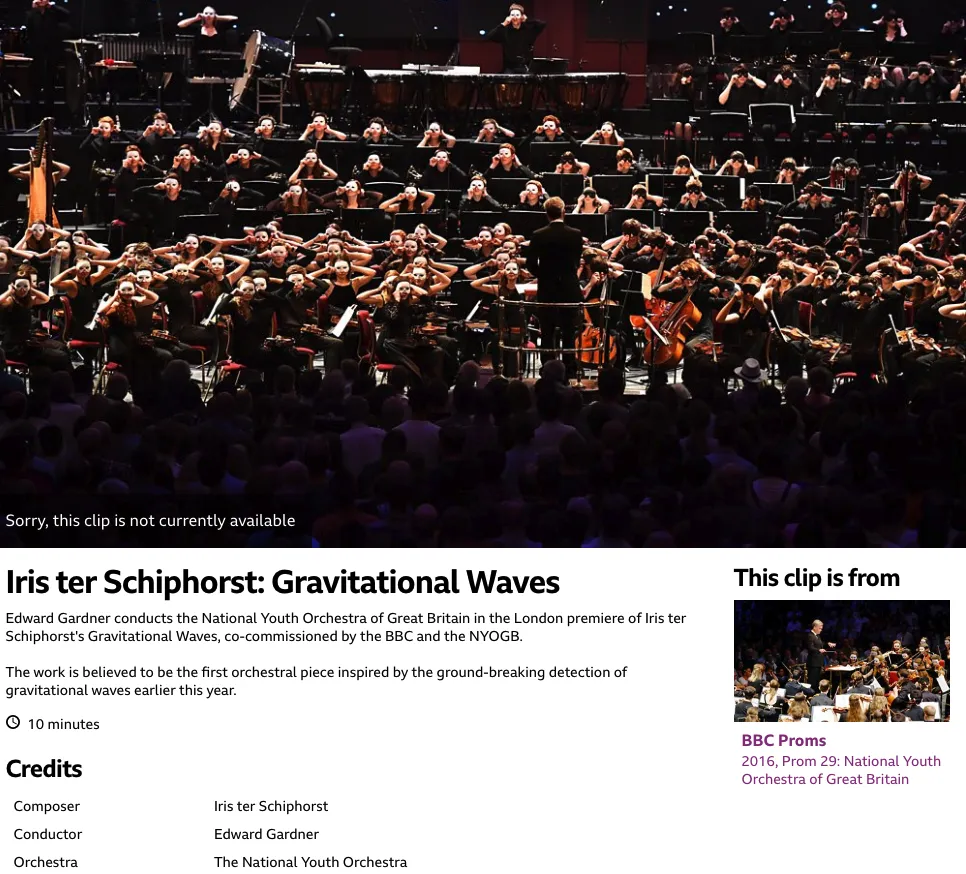
"Iris ter Schiphorst’s surging Gravitational Waves was inspired by the throb, detected last September, of two black holes colliding more than a billion years ago. She translated this into a ten-minute piece that was as much theatre – the players putting on masks, nodding, swaying and shouting with choreographic precision – as muscularly minimalist music. Both cosmic and comic, it was a dazzling showpiece for virtuoso youth." (Richard Morrison, The Times, 08 Aug 2016)"Gravitational Waves was inspired by new scientific research validating Einstein, and it summoned a novel and symbolic mix of visual, aural and vocal gestures. The synchrony, whereby the players first wore white or black masks, then embodied the waves of the title in perfectly choreographed movements rippling through the serried ranks, created an arresting counterpoint to the imaginative, otherwordly soundscape realised by Ter Schiphorst and co-composer Uros Rojko. Evanescent and evocative, embracing known and unknown, it captured something of the awesome history and infinity of time."
Brian Barford, Classical Source, 06 Aug 2016
"Schiphorst uses sounds from the scientific project heard through a sampler and reflected in the orchestra as well as a broadcast narrative. The soaring brass, scurrying strings and metallic percussion offer a sense of infinity. There is also a strong sense of visual performance, for the musicians don masks, sway in unison, make vocal interjections, and at the end raise their arms in a gesture of hope for the future. It proved an arresting piece to see and one imagines it was enjoyable to present."