HYPER-DUB (2019/2022)
for voice, ensemble and sampler (all amplified)
Text: Dirk von Lowtzow
Duration: 11 min.
Composition commissioned by the Donaueschinger Musiktage
WP: 15.10.2022, Donaueschingen Music Days, BarsporthalleDirk von Lowtzow / Talea-Ensemble, conductor Susanne Blumenthal
Performance material available from Boosey & Hawkes
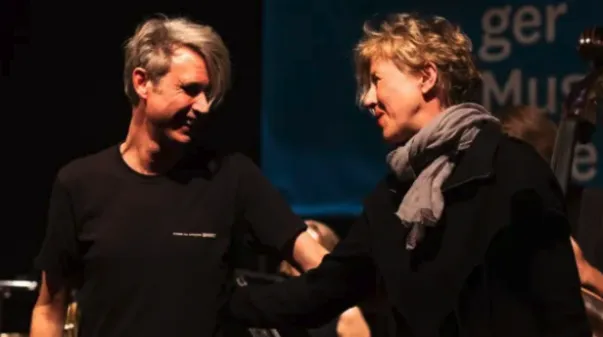
Photo: copyright Ralf Brunner
Audio: YouTube
exact instrumentation:
narrator. fl (+piccolo). cl (+bassclar)-hrn- 2 perc-harp-e-git-sample-kbd.pft-vln.vln.vla.vlc.db
Programme text
I am a re-active composer, i.e. I react to what directly concerns me, surrounds me or happens to me.
My compositions therefore sometimes create intertextual references to other works, spin on existing sound worlds or comment on them and conduct virtual dialogues.
I am fundamentally interested in making connections: to other times, to other works, to other artists.
In this respect, my composing always takes place in certain contexts - the other, as YOU, as a counterpart, is always present, be it in direct performativity or as a resonance space. In a way, this form of intertextuality can be seen as a counter-category to the concept of authorship.
HYPER-DUB also emphasises connections and references. This composition would not have come about without the surprising encounter with Dirk von Lowtzow, his wonderful text, without the enriching conversations, without the amazement at similar preferences, philosophers or artists.
And without this encounter, it might not have occurred to me to work with the recording of an ancient MS-20 sound, which holds the whole piece together like putty, microtonally colouring it, but also adding a trace of historicity.
A broken sound (mainly a slightly too low capital E, also strangely modulating in itself), the result of a spontaneous desire to experiment by the legendary Chrislo Haas (1956-2004, DAF, Liaisons, etc.), who sadly died far too early. DAF, Liaisons Dangereuses) with the MS-20 synthesiser that was so influential in the late 70s and 80s. Chrislo Haas had sent this through a defective space echo from musician and sound expert Thomas Stern (1957, including Crime and the City solution, Berliner Ring), who fortunately 'recorded' this experiment and gave it to me decades later for further processing.
HYPER-DUB is in three parts: in the first part, I layer different lines or melodic fragments onto the sound and let them merge into one another, sometimes magma-like. This creates a peculiar sonority in which recognisable elements flash up again and again, but at the same time seem to slip away.
In the second part, the space is left to the voice and the lyrics, while in the third part the hybrid instrument 'drumset' takes centre stage and gives the sound and lyrics a completely different meaning.
What touched me so much about this strange, broken sound that it has now found its way into HYPER-DUB as a recurring sample?
Perhaps that it reminds me of the early 80s in Berlin? Of the resistant and experimental atmosphere that fascinated me so much about this city back then that I decided to move there from one day to the next and throw myself into the experimental rock music scene?
Perhaps because I involuntarily associated it with my attitude to life at the time, i.e. with a time of active resistance (remember: at the beginning of the 1980s, almost 160 buildings in what was then West Berlin were squatted within a few months, meaning that buildings that had fallen into disrepair for years and had long been left to decay by their owners and politicians were gradually 'reoccupied', which meant that, for example Kreuzberg 36 was 'saved' for a new future, which would otherwise have fallen victim to politics in conjunction with speculators - in the hope of lucrative business and profitable margins in view of the motorway planned through this neighbourhood at the time).
Or, above all, that it evoked in me the question (which has been bothering me for a while now) of what has remained of this lived resistance, the supposed awakening of the time (women's movement, anti-nuclear movement, climate movement, squats, New German Wave before its commercialisation, etc.)?
In other words, what of the 'futures' that were imagined back then has been lost over time or has not materialised in the 21st century? And: When was the belief in a better and fairer future replaced by the realisation that everything, really everything, every movement, including resistance, will be 'swallowed up' by the excesses of capitalism?
Iris ter Schiphorst, 2022
HYPER DUB: Text by Dirk von Lowtzow
The penultimate glass
I drink again
In a state of
of absolute sobriety
The penultimate glass
Then I can go
Then
On the night bus
To Ostkreuz
(Hyper Dub)
Then
With the birds
Over the bunker mountain
With the bats
Over the victory column
(Hyper Dub)
This night
Will be hell
But tomorrow I will feel
Like a newborn
Feel
Risen next to the washing machine
(patron saint of gravediggers)
Come home, L.
Reviews
ZEIT No. 43, 19 October 2023, Mirko Weber
"Tocotronic singer Dirk von Lowtzow stands on the stage of the sports hall at Donaueschingen Realschule and immerses himself in his lyrics in the third round of his poem Hyper Dub. And when he's really got it down pat ("This night / Will be hell / But tomorrow I'll feel / Like a newborn / Feeling"), the clever and courageous composer Iris ter Schiphorst gives the sound engineer at the mixing desk a signal and he turns up the volume - but really: if you're going to go down, then please do it loud and clear. "Come home. L.", says von Lowtzow. In a sepulchral voice. But coming home is also a new beginning...."
FAZ, 21.10.2022, Max Nyffeler
https://www.faz.net/aktuell/feuilleton/buehne-und-konzert/donaueschinger-musiktage-2022-18401519.html
"For Berlin composer Iris Ter Schiphorst, the party is over. While cultural senator Lederer is already thinking about tomorrow and cosying up to the capital's woke scene instead of campaigning for a proper handling of the democratic elections, in her composition "HYPER-DUB", based on a text by Dirk von Lowtzow, she sings a swan song to the experience-hungry 1980s, which she evokes once again with a dull, proletarian rebel sound. A mercilessly honest self-interrogation, reminiscent of the satire by left-wing singer-songwriter Franz Josef Degenhardt of the APO grandfathers: "Yes, and then came the colder days. Some people stayed in their houses, thought of hotter times, told a few stories about them."