La Coquille et le Clergyman (2004)
Music to the film of the same name by Germaine Dulac, 1928
for 12 instruments and Cd accompaniment
Duration: 40 min.
Commissioned by the Asko Ensemble and the Eduard Van Beinum Foundation
WP: 06.04.2005 Stadsschouwburg/Amsterdam as part of the Filmbiënnale of the FilmmuseumAsko Ensemble conducted by Peter Rundel
Performance material available from Boosey & Hawkes
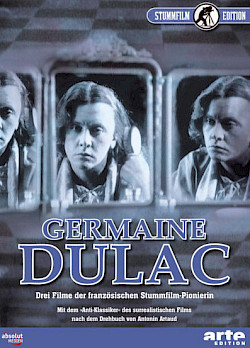
DVD Germaine Dulac - Drei Filme (1922-1928)
darauf La coquille et le clergyman (Die Muschel und der Kleriker), 1927, 40 Min.
Das erste surrealistische Werk der Filmgeschichte - nach einem Skript von Antonin Artaud.
Musik (2004): Iris ter Schiphorst
Einspielung: AskoEnsemble / Peter Rundel
arte / absolut MEDIEN 865
https://lightcone.org/en/video-3-la-coquille-et-le-clergyman
exact instrumentation:
Violin, viola, 2 cellos, double bass, 2 prep. pianos, sample keyboard, harp, electric guitar, 2 drums (all instruments amplified)
La Coquille et le Clergyman (The Shell and the Cleric)
is considered the first surrealist film in film history, made in 1927 from a script by Antonin Artaud and directed by Germaine Dulac. The premiere in February 1928 was a scandal in the best surrealist manner, although it was not so much the audience that was scandalised as the masters of the avant-garde themselves. The screening ended with the accusation that Dulac had 'feminised' the script and opened up a long-running controversy surrounding the film.
Details about the film "La Coquille et le Clergyman"
Silent film, France, 1927,
black and white, video, first release, 40 min.
Premiere: 9 February 1928, Paris (Studio des Ursulines)
Director/visual composition: Germaine Dulac, script: Antonin Artaud
Silent film, France 1928,
Director: Germaine Dulac
Screenplay: Antonin Artaud
Camera: Paul Guichard
Music: Iris ter Schiphorst
Producer: Les Films D.H.
With: Alexandre Allin (cleric), Lucien Bataille (officer), Genica Athanasiou (woman)
Restored version (2004): Nederlands Filmmuseum
Recording: Asko-Ensemble under the direction of Peter Rundel.
Sound direction: Guido Tichelmann.
Co-production: Asko-Ensemble and ZDF/ARTE with the support of the Eduard von Beinum Foundation
Germaine Dulac - Pioneer of silent film
With La Coquille et le Clergyman, ARTE presents one of the most important works by French film pioneer Germaine Dulac. The film will be shown for the first time in a recently restored version with a newly composed score by Iris ter Schiphorst.
Synopsis
Based on Antonin Artaud's novel, Germaine Dulac tells the story of a young clergyman who is unmistakably caught in the Oedipal triangle between an unattainable woman and a jovial, dominant older man. Traumatically trapped in his unfulfilled longing, he oscillates between destructive rage and castration anxiety.
Due to the slightly ironised interpretation of Artaud's original, "La Coquille et le Clergyman" was a scandal at its premiere in 1928. However, it was not so much the audience as the male representatives of the surrealist movement who were enraged by Germaine Dulac's film - even though it is considered the first surrealist work in film history. The French pioneer was accused of having "feminised" Artaud's script, opening up a protracted controversy surrounding "La Coquille et le Clergyman", which heralded a new, emphatically visual film culture.
In precisely composed shots, cross-fades and associative montages, Germaine Dulac opens up the subjective world of her protagonists, sometimes using sophisticated cinematic tricks. Even where a narrative framework exists on the surface, her stories dissociate into independent thoughts and wishful thinking, even to the point of completely dissolving a realistic time-space continuum.
Germaine Dulac (1882-1942) is the first grande dame of French cinema and as such is one of the earliest female directors in film history. As a versatile, daring filmmaker, she worked in the context of French Impressionism and Surrealism. With her feature films and documentary works (including Je n'ai plus rien, 1934, Étude cinégraphique sur une arabesque, 1929, Le diable dans la ville, 1924, and Les Soeurs ennemies, 1915), which she made until the 1940s, she was at the centre of French film criticism.
An institution during her lifetime, she fell into oblivion for several decades before her work began to be recognised again in recent years. A major retrospective in Frankfurt and Berlin (2002) will be followed in June 2005 - almost simultaneously with the broadcast of two Dulac films on ARTE - by a comprehensive exhibition of the French film pioneer's work at the Musée d'Orsay in Paris.
The two silent films by Germaine Dulacs shown by ARTE will be shown in new versions, which were elaborately produced by the Dutch Film Museum after extensive research and restoration work. These new versions not only impress with their photographic quality, which should come very close to the impression of the premiere versions, but also with the newly composed music: Composer Iris ter Schiphorst wrote a new score for twelve instruments (violin, viola, two cellos, double bass, two prepared pianos, sample keyboard, harp, electric guitar, two percussion instruments) for the anti-classic of the surrealist film La Coquille et le Clergyman, which was premiered on 6 April 2005 at the Vienna Film Festival. It was premiered at the Amsterdam City Theatre on 6 April 2005.
The British Board of Film Censors (1928):
"This film is so obscure as to have no apparent meaning. If there is a meaning, it is doubtless objectionable."
Reviews
NRC Handelsblad, 07.04.2005
The music of Dutch/German composer Iris ter Schiphorst creates a natural combination with the film...a real unity of image and music. Sometimes she follows the associations very precisely, then again she goes her own way. Ter Schiphorst knows how to elicit a very special sound from the instruments: thin and unreal. This fits the film perfectly...
film-dienst, 12/2005, Jörg Gerle
www.filmdienst.de/film/details/524402/la-coquille-et-le-clergyman-l-invitation-au-voyage#filmkritik
La Coquille et le Clergyman / L' Invitation au Voyage
...Iris ter Schiphorst goes a formal step further in her score for twelve instruments, which she created for the premiere of the restored version of "La Coquille et le Clergyman" in Amsterdam in 2005. Drawing on the atonality of the New Music of the late 1920s by Schönberg and Varèse, the Hamburg-born composer lets off steam in Dulac's associative series of images. Analogue to the visual level, the music repeatedly dissolves into adventurous tone clusters, only to end occasionally in a furtive harmony. Schiphorst avoids any inappropriate dominance that would have pushed Dulac's film too far into the background or determined its interpretation. The two film scores commissioned by arte are thus excellent examples of musically re-dressing silent film treasures without costuming them.