NOISE (2014)
NOISE – An attempt at an encounter between Mongolian and European musicians as a form of "alienation" – based on concepts by Iris ter Schiphorst and Uros Rojko
Duration: ca 50 min.
Performance material available from the composer
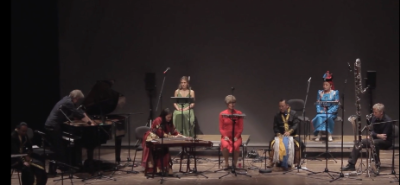
Excerpt des NOISE-Konzertes 2014 im Rahmen des Projekts „Urban Nomads“ (im Radialsystem)
In 2013, composer Iris ter Schiphorst and experimental/electronic specialist and founder of the independent label Noise Asia, Dickson Dee, held a workshop in Ulaanbaatar for students of the Mongolian State University of Arts and Culture and visiting students from the Berlin University of the Arts. Based on the different Asian and European listening cultures, a joint composition was developed.
In the follow-up project in Berlin, the framework is more "experimental": based on concepts by composers Iris ter Schiphorst and Uros Rojko, Mongolian and European professional musicians come together to make music in different formations. Traditional Mongolian playing styles meet avant-garde European playing techniques. The aim is to attempt to make contact with the unfamiliar, to set in motion "contagion processes" among the participants, a precarious state that could also be described as "igniting a crisis" that promises to trigger a transformation of the self ...
With musicians from the Mongolian group HOSOO & Transmongolia (throat singing, traditional Mongolian instruments), Berlin musicians Theo Nabicht (amplified contrabass clarinet, bass clarinet), Jörg Wilkendorf (electric guitar, live electronics), Ute Wassermann (voice), Johanna Krumin (soprano), Torsten Ottersberg/Iris ter Schiphorst (sounds, sound direction), Slovenian composer and musician Uros Rojko (amplified clarinet, half clarinet) Dashtsermaa Tserenpil (long song) and others.
The concept of 'alienation'
At the heart of the project is not fusion, but deliberate friction. Ter Schiphorst uses the term 'alienation' to describe how familiar cultural sounds can seem strange when placed in a different context. The aim was not to exhibit Mongolian tradition in a museum-like setting, but to show it as a living, resistant force in globalised modernity.
Collaboration on equal terms
An important background factor is the working method. Instead of presenting the Mongolian musicians with finished scores, much of the work was based on improvisation and mutual learning. Ter Schiphorst often emphasised how much the physical presence and breathing technique of Khöömii singing influenced his own compositional style.
The project was part of Crossing Identities – Urban Nomads, an initiative of the Schering Foundation in cooperation with Radialsystem and the International Theatre Institute (ITI). It aimed to show how artists in a networked world create new, hybrid identities without denying their roots.
Reviews
Reviews of the NOISE project as part of Urban Nomads emphasised above all the tension between the archaic and the modern. Here are the key points of the reactions:
- Sonic confrontation: Reviewers often described the concert as a "radical encounter". Criticism focused on how Iris ter Schiphorst did not "misuse" traditional Mongolian singing (Khöömii) as mere folklore, but confronted it with aggressive electronic sounds.
- Theme of alienation: The specialist audience and journalists appreciated the implementation of the theme of "alienation". The project was praised for making the destruction of identity in the globalised world audible, rather than pretending to be a harmonious "world music idyll".
- Perception in the Radialsystem: During performances in the Radialsystem, the physical intensity of the sound was often emphasised. According to reports, the combination of the meditative undertones of the horsehead fiddle and the harsh digital cuts created an almost "oppressive but fascinating density".
- Authenticity vs. avant-garde: The performances of singer Dasderma and Hosoo were particularly highlighted, as they courageously embarked on the experiment of placing their centuries-old tradition in a completely new, urban context.
- No exoticisation: A central positive point of criticism was the absence of exoticisation. Instead of using Mongolian sounds as a decorative element, they were treated as equal structural components of a new, hybrid sound language.
Today, the project is often cited as a prime example of successful transcultural cooperation that dispenses with the usual clichés of "world music".