Polaroid's melodrama (1996) (with Helmut Oehring)
for 1 deaf-mute, 1 soprano, 12 instruments and live electronics
Text: ter Schiphorst/Oehring
Duration: 22 min.
Composition commissioned by the Donaueschingen Music Days
WP: 20.10.1996, Donaueschingen/MusiktageChristina Schönfeld, Arno Raunig, Ensemble Modern, Conductor. Jürg Wyttenbach
Performance material available from Boosey & Hawkes
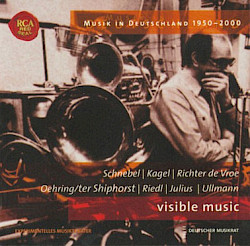
CD Deutscher Musikrat – Musik in Deutschland 1950–2000 /
visible music – Experimentelles Musiktheater
darauf ‚Polaroids Melodram’
Christina Schönfeld / Arno Raunig / Ensemble Modern / Jürg Wyttenbach
BMG Classics 74321 73651 2
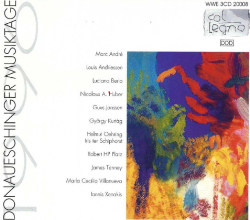
CD-Dokumentation der Donaueschinger Musiktage 1996
darauf ‚Polaroids Melodram’
col legno WWE 3 CD 20008/BMG/RCA 74321 73651 2
exact cast:
1 deaf performer, 1 male soprano, 3 trumpets, 3 perc., sample keyboard, electric guitar, electric bass, 3 violins, feeds
About the work
A man and a woman. A couple. An old story.
A soprano and a deaf-mute. A beautiful story.
(At least in appearance).
In its original version: annihilation of the other and idealisation of sound.
Sign language looks like a close-up of speech and yet, when it comes up against the senseless beauty of singing, it cannot transcend its silent film character. Its drama obscures the fact that it is not just an independent language that fulfils all systemic linguistic criteria, but the origin of language per se. Its concept is not bound to sounds that come from the throat.
The source material of POLAROIDS are short action units that are narrated in different language systems. However, they do not appear in a linear fashion, but are cut up and assembled - as in a film, for example.
The frequency with which the individual sections are created, identical to the actual development of a Polaroid, is a reflection of a linguistic gesture in space and is inflected - sometimes asynchronously to the text and plot - in different perspectives (such as normal shot, close-up, long shot, flashback and flash-forward).
In this kind of spatial grammar, music and sign language only appear to collide.
In reality, sign language, despite its soundlessness, is much more similar to the system of music than to spoken phonetic language.
The sound of POLAROIDS is largely its translation into writing.
Bab(b)ellogic.
I. ter Schiphorst, H. Oehring