PRAE-SENZ (Ballet blanc II) (1997) (with Helmut Oehring)
for violin, cello, prep. piano/sample keyboard
Duration: 35 min.
Commissioned by Ensemble ictus/Berliner Festwochen
WP: 17.09.1997, Berlin Festival Weeksictus-Ensemble
Performance material available from Boosey & Hawkes
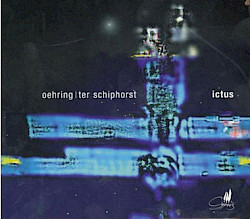
CD Komponistenpotrait Iris ter Schiphorst und Helmut Oehring
Ensemble ictus
darauf ‚Prae-senz’
CYPRES 2000, CYP5602
It starts with repetition
Patricide without end
PRÉSENCE and its double.
A ‘théatre de la cruauté’
The non-presentable.
Ballet blanc.
Reviews
FAZ 07.10.1997, Eleonore Büning
From Berlin concert halls: The premieres and revivals of the festival weeks
Snipping is the thing at the moment"Prae-Senz". A joint work by Iris ter Schiphorst and Helmut Oehring. He comes from East Berlin, she comes from Bremen, so this world premiere is the second German-German collective composition of the festival weeks. Admittedly an unpathetic one. It is also not an ordinary pasticcio to which everyone contributes a movement. "Prae-Senz" is live, electronically alienated chamber music, a trio for violin, cello, prepared piano and sampled keyboard, ripped into not easily identifiable layers of noise. The title and subtitle ("Ballet blanc II") already indicate this: The piece is intended as an homage to Bernd Alois Zimmermann's piano trio "Présence, ballet blanc en cinq scenes".
Both works were played one after the other by the Brussels Ictus ensemble: first "Prae-Senz", then "Présence", meshing the familiar with the strange, a highly irritating, ear-twisting operation. In this key piece of modernism, the great father and outsider realises his idea of the spherical shape of time in a collage of past and present - "a thin layer of ice on which the foot can only remain until it breaks" (Zimmermann). So his epigones now reverentially steal his process and make something new and appropriate out of it, in a kind of creative patricide. They cut Zimmermann's piece into pieces, as well as their own. They take pleasure in putting together what does not belong together. The next world premiere is already on the programme at the Dresden Days of Contemporary Music: "Silence moves", a kind of chamber opera "for six female musicians in motion".
This strange collective composition seems to be right in tune with the times. How does it work? At a large table. With a pair of scissors. "Snipping is the thing at the moment," say the composers. Not constructing something new according to old patterns, but first taking apart the old, cutting it up: because before construction comes deconstruction and analysis.
Article by Pierre Gervasoni, Pierre Gervasoni, Le Monde, 18 October 1998
“… an exceptional case in the so-called serious music – whether contemporary or not: a musical work written by two authors, self-taught Helmut Oehring (born in East Berlin in 1961) and his versatile companion, Iris ter Schiphorst (born in Hamburg in 1956).
Hardly known, she declares the conventional distinctions between pop, jazz and avant-garde invalid, just as the pressure to be up to date, which applies to suburbian rappers as well as to IRCAM subscribers.
The music was written by hypersensitive Helmut Oehring, who suffered a trauma in his childhood (he is the son of deaf parents who has never seemed to have recovered from the ‘sonic shock’ of learning spoken language at the age of four and a half) and Iris ter Schiphorst, a ‘pasionaria’ of multimedia performance (the former bassist and rock drummer has devoted herself to the exploration of instrumental sounds). Thus marked by an inherent sense of devastation, the music still has a precursor in B.A. Zimmermann…
PRAE-SENZ, the first piece in the programme of Brussels-based Inctus Ensemble, is a direct allusion to the German composer: the trio … entitled “Ballet blanc II” refers to Zimmermann’s Présence (Ballet blanc…) … like its precursor, it uses collage and quotations. Yet, in a radically oppositional way, the composers have banned the apocalyptic rush from their score, along with the spiritual elements. The red light of varying brightness gives the performers the impression that they have escaped into a bunker. Explosions and gunfire, understood in this sense, … are abundant.
As in a rock concert, the scenery gives the music a strange air of ecstasy …”
Article by Bastien Gallet (Paris) on the French premiere of PRAE-SENZ
On the programme ...: a new adaptation of Bernd Alois Zimmermann's ballet blanc (entitled Présence), or rather its double ("PRÉSENCE and its double" is announced at the beginning), a ballet blanc II (entitled Prae-senz) which rewrites the plot (five scenes of an imaginary ballet) and the characters.(five scenes of an imaginary ballet) and the characters (Don Quixote, Molly Bloom and Ubu Roi, embodied respectively by violin, cello and piano) of its original, in which passages from Strauss's Don Quixote and Prokofiev's Seventh Sonata have already been inserted. The cruel double ("a théâtre de la cruauté" [theatre of cruelty] is what one voice has called it) by the Oehring / Schiphorst pair brings this to bursting point - tearing apartIt tears apart what the original was only able to hold together with great effort, this "fragile layer of ice on which the foot can only remain until it breaks" (according to Zimmermann). And in this way: Scene 1, introduction and no plot (Don Quixote), the sample of the first bars from the second movement of the Seventh Sonata or an imperfect cadenza (right hand) over a wavering bass of a dance in two-four time (left hand), rhythmic cell whose imbalance (acceleration, which the musical persona that emerges here in broad outlines - Don Quixote? - seems to find difficult to bear and which sweeps him into something that could be interpreted as a fall - from a horse? - from a horse?) can be found throughout the entire scene, which callously interrupts an electronic eruption from which a woman's voice soon emerges announcing the day's programme: tricky. What follows is a succession of snapshots (it is no coincidence that Polaroids is the title of one of her pieces, subtitled "Mélodrame"), of repetitions (cells that have to be repeated two or three times), of varying landscapes (like this loop of Chopinesque loveliness under the hysterical screeching of the strings), without ever losing the limping rocking motion of Prokofiev's sonata.
Her music uses music (musics) as an occasion for stories and tries to show what she lets us hear by using them (the musics) like opaque signs (blood, tears, violence, hate, death, love) of a contemporary sound-image tragedy. (Bastien Gallet)
I detest every sign.
I throw it out, I discard it (I give it back its deadness).
I only create machines instantly useful.
Momentarily useful or usefully instantaneous.
I will never poop again.
I will make myself a new body: one that ejects nothing.
(Antonin Artaud)