REQUIEM (1998) (with Helmut Oehring)
for 3 countertenors, 12 instruments and live electronics
freely based on the 9 psalms 'O Ye Tongues' from the 'Death Note Books' by Anne Sexton
Duration: 55 min.
Commissioned by the Donaueschinger Musiktage in co-production with the Festival d' Automne à Paris, Kaaitheater, Brussels, Philharmonic Society of Brussels, Ictus
WP: 13 October 1998, Opéra National, Paris, Festival d’AutomneDE: 18 October 1998, Donaueschingen, Donaueschingen Music Festival
: David Newman / Arno Raunig / Jean Nirouet / Ensemble Ictus / Georges-Elie Octors
Performance material available from Boosey & Hawkes

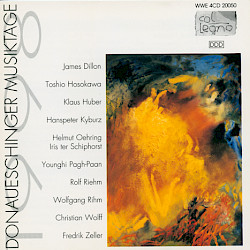
CD-Dokumentation der Donaueschinger Musiktage 1998
darauf ‚Requiem’
col legno WWE 4 CD 20050)
exact instrumentation:
3 countertenors, basset horn, contrabass clarinet, 3 trumpets, 2 trombones, 2 perc. piano/sampler/harmonium, electric guitar, electric bass, violin, viola, cello, additional parts
DE: 18.10.1998 Donaueschingen, Donaueschinger Musiktage
Reviews
Süddeutsche Zeitung, 21 October 1998, Ulrich Schreiber
All sorts of things are true
The Donaueschingen Music Days with new, outlandish and familiar pieces...And here in Donaueschingen, of course, also for pieces by Matthias Spahlinger and Wolfgang Rihm, Klaus Huber and Christian Wolf, Toshio Hosokawa and the still young couple Helmut Oehring / Iris ter Schiphorst, to name just the most important composers in this year's programme.
The large one-hour "Requiem", now presented in its German premiere at the Donauhalle, is already the seventh joint work by Oehring and ter Schiphorst, who in recent years have come to the fore with compositions that are as riskily difficult as they are impressive. It is certainly daring to choose the Mozart Requiem as a "pragmatic starting point" for a new composition and it is just as daring to try to hold one's own against the declared great old "role model" with an excessive collage of material. The text by Anne Sexton ("Nine Psalms" written in a language "on the edge of existence", as Oehring says) probably plays a rather subordinate role.
In any case, the predominant sound principle in this "Requiem" is a precise and unleashed montage of heterogeneous musical elements. The structure according to the traditional Latin requiem scheme, which is intended to give the work formal stability, is sometimes wildly overgrown by the most adventurous sounds and sound overlays:Music alternately located in zones of silence and noise, piled up orgiastically or spun out in madrigalesque linearity (by three countertenors). The solo piano, the electric guitar and the live instruments (Ensemble Ictus), classical and rock sounds naturally or electronically alienated through playback and sampling technology, the whole thing is held together and virtuously controlled by the two composers at the gigantic mixing desk in the centre of the hall. The experience of the advanced contemporary, the precisely fragmented, the vitally torn, the self-assuredly strong, never larmoyant pathos outweighs the objection that the verdict of pure "festival music" - which can only survive in proud catalogues of works - could be referring to just such a piece.
Le Monde, 18 October 1998, Pierre Gervasorri (translation from French by the publisher Boosey & Hawkes)
RESOLUTION OF VALUES
The choice of a requiem as a response to the Festival d' Automne commission is not surprising. Its realisation is all the more so. 15 instrumentalists (some equipped with sophisticated electronic equipment) and three singers energetically submit themselves to the craziest dissolution of musical values of this century. Gravediggers of a culture of the work, the composers retain from the music only the manifestation through vibrations (waves?), little modulated, not systematised (in order), completely liberated. Oscillation (?) of the funeral march, intoned by two trombones (original Mozart) over an alpine dream-like pulsation of the tutti; vibrations of a folk procession (pathetic fanfares) and general signs (sirens, Larsen effects, from which a lone guitarist emerges); vibrations of horror (composed with sounds related to a crowd of evil spirits); vibrations of religious distortions (synthesiser with characteristics of a harmonium).
Conflictual from beginning to end - you will have understood - this requiem will not bring peace of mind. Nevertheless, it provides moral consolation at a time when contemporary music is increasingly confronted with the question of the irrelevance of language.