Silence moves (1997) (with Helmut Oehring)
a kind of chamber opera for voice, violin, cello, electric bass, prep. piano/sampler, tapes, video installation and live electronics
Duration: 60 min.
Auftragswerk im Rahmen des Wettbewerbs BLAUE BRÜCKE, gefördert vom Dresdner Zentrum für Zeitgenössische Musik
WP: 12 October 1997 Dresden, small theatreConcept,text and overall design: Iris ter Schiphorst
Video installation: Susu Grunenberg, Sharron Sawyer
Computer animation: Lioba van den Driesch
Additional performers: Torsten Ottersberg and Helmut Oehring
Ensemble intrors:
Voice – Anna Clementi, Violin – Susanne Schulz, Cello – Marika Gejrot,
Electric bass – Maria Rothfuchs, Prepared piano/sample keyboard – Iris ter Schiphorst
Choreography – Christian Kesten
Performance material available from Boosey & Hawkes
First Prize at the BLAUE BRÜCKE International Composition and Performance Competition, Dresden-Hellerau
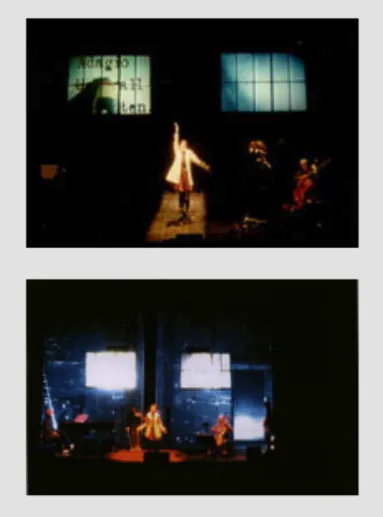
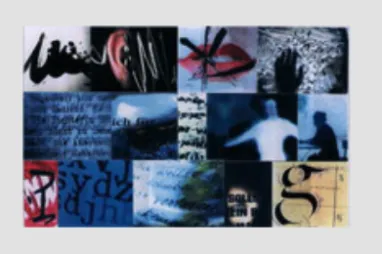 Photos: Susu Grunenberg
Programme booklet
Silence moves is a kind of chamber opera for five musicians in motion, live electronics, lighting, recorded music and video projections, which plays with the multi-layered connections between seeing and hearing, and signs and sounds.
However, this is by no means a harmless story.
Rather, it is one of writing, absence and death.
And one of confusion.
In which one sometimes no longer knows exactly where one actually is…; whether one is watching a radio play or listening to a film, whether musicians are performing or actors are giving a concert.
Silence moves is neither about providing a musical backdrop to images, nor about ‘illustrating’ music, but rather a composition that requires both eye and ear for ‘understanding’. In other words, precisely those senses that, in ‘our’ alphabetic, phonetic script, interact most closely anyway – even if the role of the ear in reading or writing is often overlooked (writing always belongs to an invisible voice too – as the secret ruler of the scene…).
In other words, it is not so much about the relationship between image and music, but rather about the relationship between writing and sound; about a ‘staging’ of the (history of) writing, which is also the (history of) language. (copyright Iris ter Schiphorst 1996)
Composer’s notes:
In *Silence moves*, I wish to explore the very particular relationship between writing and sound, or between seeing and hearing, in ‘Western music’, and to present it ‘musically’: as ‘audible writing’ and ‘visible sound’. In this context, I believe that ‘Western music’ cannot be conceived without the ‘inscription’ of bodies (the training of specific bodily functions and rhythms at the expense of others, etc.). I wish to make these ‘inscriptions’ – which tell a very different history of ‘Western music’ – legible and re-present them.
Iris ter Schiphorst
See also interview with Iris ter Schiphorst on ‘Silence Moves’ on the occasion of a work presentation at the Spor Festival 2015 (theme: ‘STAGING THE SOUND’)
Reviews
Sächsische Zeitung of 6 October 1997 (Friedich Streller):
Scenic fantasies/perfect performance for the contemporary music days
As part of the biennial "Blaue Brücke" competition, the ensemble "intrors" performed on Saturday at the 11th Dresden Days of Contemporary Music in the Kleines Haus. ...The programme included the world premiere of a spatial performance for voice, instruments, tape, video projections and live electronics. For me, the musical-scenic event developed as a kind of chamber opera into a new kind of Gesamtkunstwerk. The sequence of scenes from 'Stille' (Silence) about death, loneliness, numbness, the search for words and language was exciting - not told verbally and logically, but artistically encoded in images. The programme revealed five parts. Eight movements, it seemed to me, organised like a chamber symphony, illuminating different perspectives and returning at the end to the beginning of that moving silence whose first word is death. And the search for language, for eloquent expression characterised the end.... It was a perfect show, impressive, even if not immediately understandable, but perceptible
The search for language was exciting - not verbally logical, but artistically coded and told in pictures. The programme revealed five parts. Eight movements, it seemed to me, organised like a chamber symphony, illuminating different perspectives and returning at the end to the beginning of that moving silence whose first word is death. And the search for language, for eloquent expression characterised the end.... It was a perfect show, impressive, even if not immediately understandable, but perceptible.
TAZ of 14 October 1997 (Waltraud Schwab)
"Silence moves" - Compositions by Iris ter Schiphorst
... At the beginning of her piece "Silence moves", which was performed at the Podewil, rhythmised strokes, lines and fragmentary images are projected onto a transparent screen. A confusing dynamic is created, accompanied by a background noise: Is that enchanted shuffling through rain and falling leaves in a synthetic city? Is that car noise in the fading light? The musicians of the electro-acoustic formation "intrors", who are visible behind the screen, take up the initial impressions and insert them into an idiosyncratic order between self-expression and silence. "Someone is dead" is the sparse message that conceals a motif around which "Silence moves" revolves. It is about the beginning and end of language and perception.
In the course of the piece, images replace music and music replaces images. ... Last week, Iris ter Schiphorst received the Dresden "Blaue Brücke" composition prize for interdisciplinary projects for this "kind of chamber opera". In earlier works, she broke up the musical space, now she is reconstructing it. Set pieces from the familiar are placed like anchors. ... But since what is recognised no longer makes sense, it becomes clear that something else is at stake. A loss of communication, a loss of coherence, a loss of language. "Why such a sad play?" she is often asked. "It was written in a sad year" is the answer.
Berliner Tagesspiegel 12. 10. 1997 (Volker Straebel)
Author with sampler/stage radio play: Iris ter Schiphorst's 'SIlence moves' at Podewil
...In her "Silence moves", Iris ter Schiphorst has created a surface in which elements of radio play, film and theatre interlock coherently. The overture opens in clean surround sound with changing soundscapes, noisy radio texts and the projection of a deliberately scratched film onto a gauze curtain - elements that are used again as inter-act music. An off-screen narrator hints at the play's broad associative space, which in the following scenes is focussed on individual isolation and the will to express oneself linguistically.
This happens in oppressive images that follow a coherent, fast-paced dramaturgy. ... The ensemble "intrors" with electric violin and electric bass, cello and the author on piano and sampler accompanies Anna Clementi, who shines vocally despite her brittle surroundings, with ostinati committed to pop and rock. Each scene is thus given its own characteristic, thoroughly coherent musical material. However, the hour-long "Silence moves" gains its entertainment value from the complexity of its multimedia references.