Studien zu Figuren/Serie A (Studies on figures/series A) (2010/2011)
for 7 amplified voices and sampler
dedicated to the Neue Vocalsolisten Stuttgart
Duration: 23 min.
Donauerschingen Music Days
WP: 16.10.2011, Donaueschingen, Donaueschingen Music DaysNew Vocal Soloists Stuttgart
Performance material available from Boosey & Hawkes
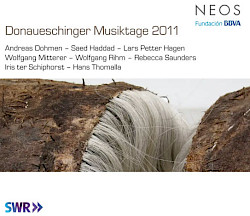
CD-Dokumentation der Donaueschinger Musiktage 2011
darauf ‚Studien zu Figuren/Serie A’
Neue Vocalsolisten Stuttgart, NEOS 11214-16
exact instrumentation:
3 sopr. contertenor, tenor, baritone, bass, sampler
Inspired by Franz Kafka's Researches of a Dog, works by the Irish painter Francis Bacon, as well as the story of a woman completely unknown to me, whom I met by chance on a walk.
Intro: Good afternoon!
1st movement: Elevator to hell (please don't believe everything)
2nd sentence: There you go!
3rd sentence: For whom
4th movement: The journey to the end is short
Programme text
My "Studies on Figures" are a top-down view of an absurdly acting collective. I was inspired by Franz Kafka's "Researches of a Dog", works by the Irish painter Francis Bacon, especially his approach to the creative process, and the story of a woman I didn't know at all, whom I once met by chance on a walk along the Berliner Landwehr-canal.
Just as in Kafka's story the "music of the dogs" reveals to the narrator their essence in physical expression, I am interested in music as human expression. I am convinced that tones and sounds have always been connoted with people's attitudes and states of consciousness. I have often written that music is a language for me, but not in the romantic sense as an expression of innermost feelings. Rather, I believe that sounds, tones, phrases and movements have always been an expression. And as in Kafka's story, the role of the "other", the listener, is essential. In receiving, in listening, we are constantly, albeit mostly unconsciously, searching for this expression - and occasionally we find it. Listening is an essential and deeply human process, because the searching listening, the searching listening for resonance, for an answer, whether within me or from outside, is at the same time always an expression of a search for small contexts of meaning in a dark, absurd world.
The story of the canal is also about the search for connections in the expression of a woman completely unknown to me. In an almost Kafkaesque manner, the narrator endeavours to solve her own problem in free associations about a topic randomly set from outside, or to become aware of it at all and to track down possible connections of meaning. However, this is not done through reflective analysis, but rather through the looping circling of an apparently larger complex of one's own problems. Starting with a dog limping through the park, the subject here becomes one's own sick cats, an impending eviction suit and finally, presumably, one's own unemployment, all of which are summarised in what appears to the outsider to be a completely incoherent statement.This is expressed in the statement "even the unemployed can afford a pet", which seems completely incoherent to the outsider and may implicitly allude to the whole complex of possible guilt over the death of one of his own cats.
For Bacon, the creative act is the attempt to find the image that one already carries within oneself using a wide variety of techniques, such as chance operations. If you miss the inner image, the work is a failure, but sometimes you find the right moment to finalise it. The aim of penetrating the essence of a personality, as Kafka's dog formulates at the end of the story, is also found in Bacon's work. His main problem when painting portraits is "to find a technique with which one can reproduce all the vibrations of a person... Whoever sits for a portrait is made of flesh and blood, and what must be captured is what they radiate". An initially nebulous inner vision only gradually materialises in the course of production and through the choice of material. Nevertheless, it is not the original vision of a work of art that is decisive, but its gradual transformation in and through the working process, its expression. The idea is something different from the actual realisation. But without an inner vision, a work is dead.
Iris ter Schiphorst
'Studies on Figures/Series A' on YouTube
Reviews
andersmusci, Johannes Anders
Also worth mentioning are the "Studien zu Figuren / Serie A" for 7 amplified voices and sampler by Iris ter Schiphorst with the magnificent "Neue Vokalsolisten Stuttgart" with a fascinatingly intense, quasi-polyphonic mosaic of voices, sounds, screams, shouts, noises and tape.
nmz (on the Bremen performance at the 2012 'Freie Auswahl' festival)
"... finely veined pieces by Andreas Dohmen and Iris ter Schiphorst, structured with pointedly placed breaks and general pauses - strong positions of choral music as immediate contemporaneity. "