Transformationen III (2022/2023)
for amplified viola and violoncello
freely adapted from the poem 'Diepe tijd' ('Deep Time') by Dominique de Groen
Duration: 9 min.
Composition commissioned by the Oh-Ton Ensemble, sponsored by the Ernst von Siemens Music Foundation
WP: 26/05/2023, OldenburgOh-Ton Ensemble: Nefeli Galani - viola, Niklas Seidl - violoncello
Performance material available from Boosey & Hawkes
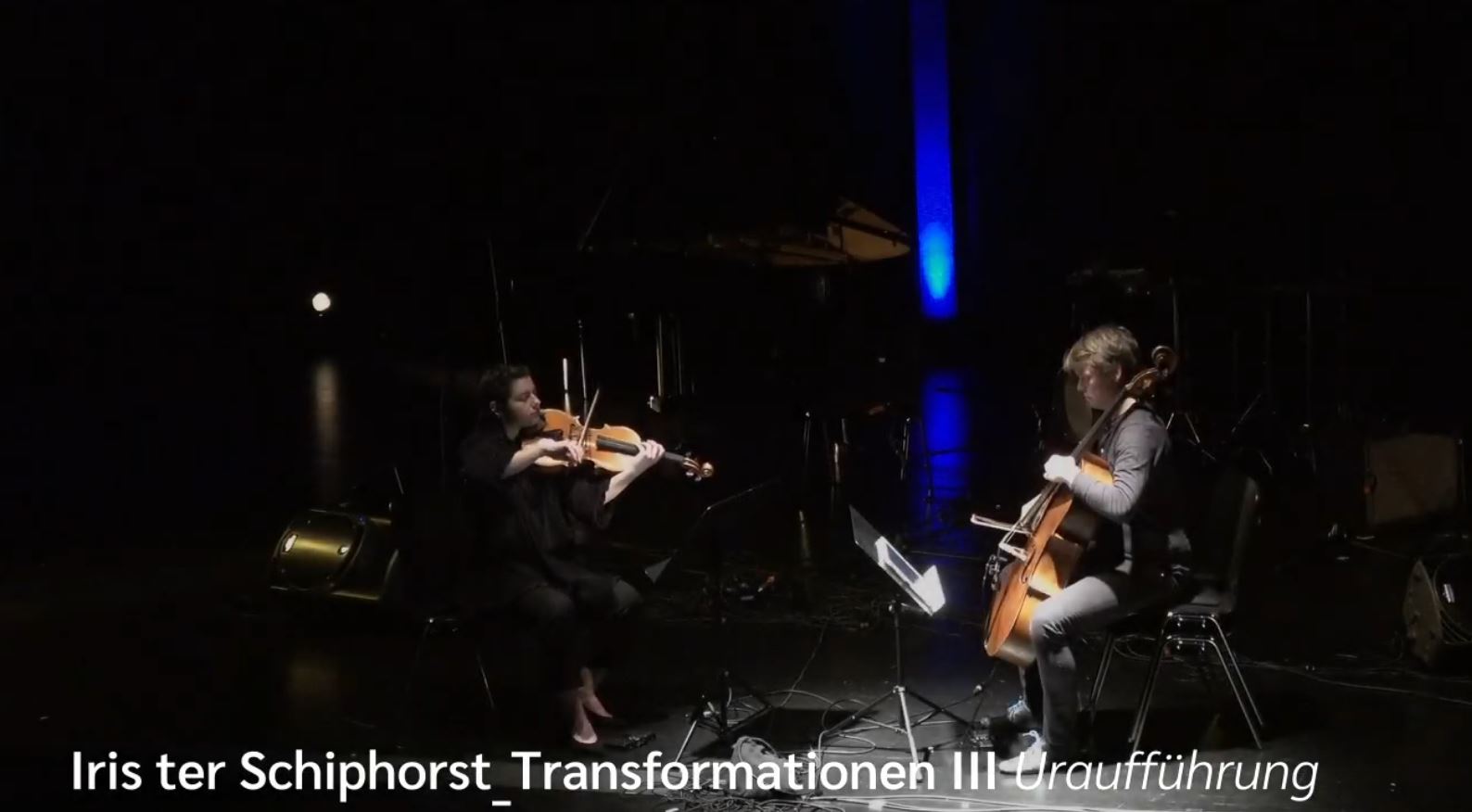
Content:
Several layers of time and media are superimposed in 'Transformationen':
- the music play is based on an old recording of a piece from 1989 (recorded at the time by the violinist Susanne Schulz and myself on the synthesiser/sampler), which has now been edited and reassembled for the 'Transformationen' series. The basis for the piece at that time was, among other things, field recordings of frogs that I had recorded in the 1980s with a Sony Professional at a watering hole in Spain and then edited in a Casio sampler (with 1MB storage capacity!). (Today this waterhole and the frogs no longer exist there - and the Casio-FZ1 sampler is now only used as a term in stories about the beginnings of sampler technology).
- The voiceover is a recording of a voice from March 2022 reading the text of the above-mentioned poem.
- The live musicians add another dimension of time and space.
In the 'real time' of the performance, different layers of time and space intermingle: 'archaeological' sounds from the feed, an acousmatic voice and the 'live' sound of the string duo.
In a way, this approach echoes the title and content of the poem 'Diepe tijd' (deep time) by Flemish writer Dominique de Groen. The term was introduced by the writer John McPhee in 1980/81 to describe a time dimension of millions or even billions of years, which does justice to the slow evolutionary processes on earth - and for which the human consciousness cannot grasp.
Technical information:
The playback consists of two audio files (44.1 khz, 16bit):
1.) the spoken text - beginning with a long pause
2.) the 'music' (stereo) or even billions of years to denote the slow evolutionary processes
Both files must be started at exactly the same time. This requires appropriate playback software and a multi-channel mixing console.
Amplifier system
Different amplifier boxes are desirable for optimum projection in the room in order to separate speech, music feed and live music from each other.
The music feed should 'frame' everything else, i.e. be played via large, powerful stereo speakers over the entire stage area.
The speech tape should preferably be projected via one (or two) extra speaker(s) placed on the stage - and thus mark a 'separate' space. The lyrics must be clearly understandable, both from the audience and from the musicians themselves (as it structures their various interventions).
If possible, the live musicians should be amplified via local stereo speakers. The musicians' sounds mark out their own acoustic space in the playback environment. They must stand out acoustically from the music feed, thus acoustically representing a layer 'in front' of the feed. 'In front' means more 'directness' but also a little more volume (the feed itself contains significant reverb components, so the way it is mixed already makes it seem 'further away').
The music feed is available in a dynamically mixed version. Depending on the room, it may be necessary to adjust certain parts from the mixing console.
Amplification:
If possible, the string instruments should be amplified with powerful clip microphones. If necessary, the cello should also be amplified with a stand microphone. Depending on the room, it may be necessary to add some reverb to the instrumental sounds.
The musicians themselves should wear headsets if possible in order to make the vocal articulations audible and integrate them into the overall acoustic picture.
Live music:
Following the logic of the poem, the piece 'takes place' in the time after humans and thus belongs, if you like, to the genre of 'science fiction'. Accordingly, in 'Transformations III' there is hardly any 'human' expression in the form of music as we are used to: Lines, progressions, phrases, bows etc. Instead, we hear cell-like, sometimes repetitive and slightly varying punctual figures that run parallel to the tape and harmonise in register with the tape. In their expression, these punctual sounds are sometimes reminiscent of the delicate lamentation of non-human beings. The sounds to be found are thus intended to appear 'creaturely' in their delicacy and indeterminacy. Only at the very end is there a 'traditional' musical passage reminiscent of (human) times long past.
Timing/coordination with the tape:
The dense musical interlude determines the piece. It defines sound spaces (registers, 'keys') that also influence the live music. The musicians must therefore be able to follow the musical feed well in order to be able to 'play along' accordingly.
Attention! - the course of the feed is not always notated exactly! Also, the tempo is sometimes more fluctuating than is notated (e.g. that of the violin part in the long opening section).
The spoken words are decisive for the overall coordination; they enable the musicians to orientate themselves in time and must be followed in any case! Certain passages of music may have to be adapted/interrupted/faded out etc. if the performance and live music move apart. The material notated in the score is therefore to be understood as a suggestion. It may be possible to deviate from this if the basic intention of the piece is retained.
Dynamics of the live musicians:
The volume levels notated in the score must be readjusted in each room. However, the ratios should be maintained. It may be necessary to play certain passages as a whole one or more dynamic levels louder or softer.
Deep time
In the nuclear twilight zone
the animals, plants
and minerals of the islands
Aeons pass:
Cactus teeth
Birgus cen
Limulidae zän
the colours draw out of the things
flow into each other, merging into the sand
ever more intense
ever more saturated
and all the markets
that have been
piled indiscriminately on top of each other
until the whole dilapidated
dilapidated structure
collapses in on itself
and forms a hard geometric puddle
in which the animals swim
in the middle of dead money.
New organisms emerge everywhere
in an explosion of life
Cambrian-like.
On an ancient island
of plastic
polystyrene mosses proliferate
in the shade
in the shade of time-honoured polyester trees.
This is where the spirits of men live.
© Dominique De Groen Translated into German with the kind permission of Dominique der Groen:; Iris ter Schiphorst
From: Sticky Drama
Gent: het balanseer, 2019