Vergiss Salome (Forget Salome) (2012)
for singer/performer, feeds and light,
Text: Karin Spielhofer based on an idea by Iris ter Schiphorst
Duration: 7 Min. min.
Sarah Maria Sun
Performance material available from Boosey & Hawkes
Program Note
"Vergiß Salome!" presents a psychogrammatic portrait of female desire, intentionally distancing the work from the traditional, male-dominated perspective of the Salome figure. Composed as a commissioned work for soprano Sarah Maria Sun, the piece merges highly virtuosic singing with theatrical performance.
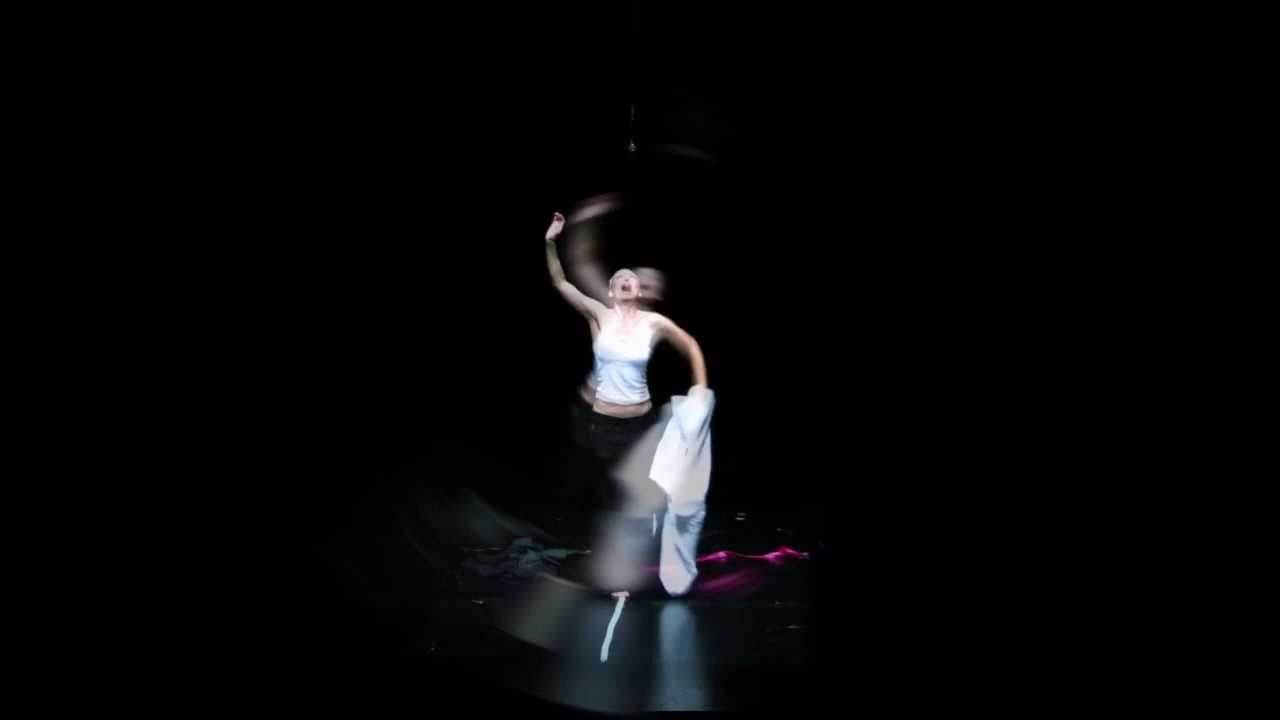
The sonic foundation is a recorded track featuring the voice of Almut Zilcher. The text, written by Karin Spielhofer, employs the metaphor of a lonely ice skater and serves as a relentless "temporal framework" for the live singer. Following a line marked on the floor, she must coordinate her vocal actions with a precise choreography of movements and the shedding of garments.
In the multi-layered encounter between the reciting voice on tape and the reacting live soprano, a field of tension arises that makes the process of searching and conjuring audible. A central moment of silence—a grand pause at the line "As if everything were starting from the beginning"—opens a space for the fleeting utopia of a fresh start before the work hurtles relentlessly toward its conclusion.
copyright 2025 Iris ter Schiphorst
Notes on the piece
A microphone hangs from the stage ceiling, but it is 'too high' for the performer, i.e. she can only reach halfway if she stands right underneath it and on tiptoe (see below for the position). 'Salome' comes on stage, wearing an inconspicuous wig, a suit that is (slightly) too big (Frieda Kahlo - similar), in which she is dressedShe looks a little lost in it, with a matching waistcoat, a white (men's) shirt, a tie, men's shoes and dark socks. The slightly oversized trousers are held in place by braces and a belt. Salome's 'outfit' is rather androgynous, although she is wearing make-up. The sleeves of the suit are a little too long.
She is holding a piece of chalk in her hand - not visible to the audience. She walks briskly to about 2 metres in front of the edge of the stage (in the middle), looks over the audience, then bends down and draws a line with her chalk within about 6 seconds from her position about 2.50 metres backwards without turning backwards. (The chalk line includes the microphone, i.e. it must be drawn under the microphone in such a way that it starts approx. 50 cm in front of the suspended microphone and ends approx. 2 m behind it (= 2.50 m line length).
When she has drawn the line, she puts the chalk down, stands up, stands with her legs closed on the line she has drawn (which 'starts' between her feet), waits a very short moment and then begins her step choreography on the line; the steps are marked on a separate line on a line with arrows pointing upwards (= forwards) and downwards (= backwards). Double arrows means 'on tiptoe'; the arrows are also labelled with letters:r = right foot (leg) forwards (weight on right foot)R = right foot backwards! (weight on right foot)l = left foot (leg) (weight on left foot)L = left foot backwards! (weight on left foot)b = weight on both feet (legs).
The step choreography is as follows: the singer places one foot in front of the other on the line, the weight is shifted/held on the stepping foot: the body direction points continuously forwards towards the audience. Backwards therefore means placing one foot backwards on the line without changing direction or turning round. If you remain in one position after a step, the weight should be shifted from the stepping foot to both feet = b! 'Salome' takes smaller steps (quasi foot in front of foot) in the initial faster rhythms and larger steps (both backwards and forwards) in the slower rhythms. The size of the steps should be chosen so that the last position (on tiptoe) ends up almost exactly under the microphone (i.e. approx. 2 metres from the back end of the line or 50 cm from the front beginning of the line). There are 7 'rows' in the piece, each with 7 steps, which become slower and larger from row to row.
The steps should be taken with full concentration on the line drawn with chalk and superfluous movements should be avoided. The slower the steps become, the more difficult it is to maintain balance. This is intentional; i.e. it is quite deliberate if the balance is not always successful, but there should never be deliberate 'fidgeting'. During the 'walking on the line', an item of clothing is removed at certain moments (see score). After taking it off, it is simply dropped. At certain moments, 'Salome' also has to stand on her tiptoes; here, too, it doesn't matter if she can't keep her balance.
See also the interview on the occasion of the Danish premiere at the Spor Festival 2015 (motto "Staging the Sound")
Reviews
Reviews of the revival at the Stuttgart Summer 2013
Eßlinger Zeitung, Martin Mezger
The second music theatre contribution to the new music festival "Der Sommer in Stuttgart" at the Theaterhaus was far more absorbing and fascinating than this world premiere. In Iris ter Schiphorst's "Forget Salome", soprano Sarah Maria Sun first sticks a strip to the floor, which becomes an imaginary balance beam of vocal artistry. In Karin Spielhofer's text, the legendary title character with her seven-fold veil dance devours herself in her own pirouette, dissolving into the moving ornament of herself. Schiphorst's composition ingeniously mirrors this in the web of colouratura, which Sarah Maria Sun sings gloriously into the swelling vortex of the electronic tangle of voices: as if only the tip of the art song, ambivalent between dressage and expressivity, still protrudes from the maelstrom of flooding alienation.
Kulturmagazin, Susanne Benda, 24. 6. 2013
Enigmatic artificiality
The fact that the production of "Kolik" was perhaps a little too realistic was evident in the second staged piece of the opening concert: Iris ter Schiphorst's "Vergiss Salome" leaves Titus Selge in a compellingly enigmatic artificiality.With natural virtuosity, soprano Sarah Maria Sun dances around the motif of Salome's veil dance on a white line with wide interval leaps and high colouratura, disrobing the disguised man-woman as she sings, until finally even the wig falls off. With Iris ter Schiphorst, the content and duration of the piece fit together well. But who the hell is Salome?