Whistle-Blower (2020/2021)
for amplified solo recorder, sampler and string orchestra
Duration: 15 min.
Commissioned by the Kunststiftung NRW for the soloist Jeremias Schwarzer as part of his project "New Recorder Concerts"
WP: 02.06.2021, Elbphilharmonie, HamburgJeremias Schwarzer, recorder; Ensemble Resonanz, conductor Peter Rundel
Performance material available from Boosey & Hawkes
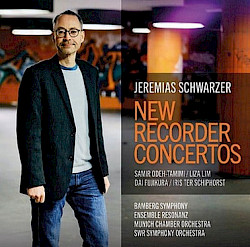
(digital album) Jeremias Schwarzer NEW RECORDER CONCERTOS
darauf ‚Whistle-Blower’
Jeremias Schwarzer, recorder / Ensemble Resonanz / Peter Rundel
New Focus Recordings fcr430
Preis der deutschen Schallplattenkritik 03.2025
Programme booklet text
'Whistle-Blower' was composed for the exceptional flautist Jeremias Schwarzer, who not only inspires with interesting and unusual programmes, but also stimulates new compositions for his instrument with great curiosity and enthusiasm.
The première of the complete version is the result of a multi-layered working process between composer and flautist, which is based on a very specific process, 'performative composing'. It refers to what the feminist performance theorist Della Pollock calls 'performative writing', which was transferred to the compositional process by the composer.
With the help of this process, different layers of times, states, intensities, languages and also physical gestures are condensed into a unique 'code'.All these layers originate from 'performative settings' between soloist and composer.
In the performance, the soloist 'translates' this complexity, which has congealed into code, into writing, into a living 'now-time'.The string orchestra acts as an attractor, providing the soloist with rhythmic patterns.
And what does the title 'Whistle-Blower' have to do with it? And how does Chelsea Manning come into play?
The term 'performative composing'
In a first step, a setting was created for the soloist in which he or she had to improvise according to certain instructions drawn up by the composer.
These improvisations, or more precisely: these 'performances' were recorded and further processed in various ways in subsequent steps (transcribed, edited, cut up into samples, etc.). It was important to find a setting that would enable the soloist to achieve a kind of 'proper time' in these improvisations, these 'performances', a form of 'isomorphism' (simultaneity) of the performing body (i.e. trained movements), hearing/seeing, perception/thinking. For in the improvisational situation of a performance, in this special form of highest concentration, something can take place under favourable conditions that cannot be invented in the medium of writing alone.
As described, this approach is based on what the feminist performance theorist Della Pollock calls 'performative writing'. Pollock writes of 6 criteria which, for her, constitute 'performative writing':
- 'Performative writing' works citationally by reflecting and enacting itself within what has already been written (or recorded, I.t.S.): "Citational writing figures writing as rewriting, as the repetition of given discursive forms that are exceeded in the 'double-time' of performing writing and thereby expose the fragility of identity, history, and culture constituted in rites of textual recurrence."
- 'Performative writing' evokes the absent (the 'original' performance of the soloist) without merely representing it. Through various acts of re-reading, re-staging and reflecting (on the recorded), something new and different emerges, which nevertheless remains connected to the absent (the 'first' performance).
- 'Performative writing' (composing) rewrites! - i.e. it consciously takes up the manifold differences between sign and signified and plays with them; at no point does it believe in the identity of sign and signified.
- Performative writing (composing) evokes an infinite chain of 'translations' (transformations). (In concrete terms of the composition process, this refers to the various ways in which the source material is transferred through media-technical processes such as spectral analysis, translation into midi, translation into notation/notation, translation into audio, translation into notation, translation into a performance in the rehearsals and the première).
- Performative writing always begins with a 'performance', the most important characteristic of which, apart from its 'fleetingness' (and 'uniqueness'), is the greatest possible isomorphism (simultaneity) of body/trained movements, hearing/seeing, perception/thinking. This 'initial performance' is - like every performance - unrepeatable and unrepresentable.
- 'Performance writing' is permeated by very different temporalities! Time of performance, time of 're-reading', time of re-writing (= time of media-technical adaptations), time of the 'concert event = UA). copyright Iris ter Schiphorst
Film (of the Corona version) by Wiebke Pöpel : YouTube
Reviews
Ensemble Resonanz plays political thriller with recorder
by Daniel Kaiser, 02.06.2021
https://www.ndr.de/kultur/elbphilharmonie/Ensemble-Resonanz,ensembleresonanz192.html
...Dutch composer Iris ter Schiphorst has set the story of whistleblower Chelsea Manning and her revelations about a US airstrike with civilian victims in Iraq in 2007 to music - appropriately as a recorder concerto. The "whistleblower" Jeremias Schwarzer initially holds his instrument 'wrong' - like a flute. He blows into it, and yet only soundless air comes out. He sings into his instrument, dismantles flutes, blows into them from different sides and desperately searches for a tone. In the end, he duplicates the sound of the recorder to create a shrill, alarmist whistle sound - the sound of the whistleblower!
The orchestra attacks the whistleblower acoustically with blows, blows and sharp lashes - somewhere between "Psycho" and "Jaws". The musicians beat on their instruments and declaim sounds and texts: The women explode vowels, the men consonants. Insults are shouted in chorus. Recordings of radio traffic during the attack in Iraq are played. Shots are heard. It's a thriller, a radio play - an Elbphilharmonie crime scene! With Iris ter Schiphorst's composition, Ensemble Resonanz has created a piece of oppressive music theatre that deeply explores the state of mind of the whistleblower - his fears and doubts, but also his courage. This quarter of an hour is moving.