Writing music in the 21st century: Pen, ink or laptop? (2019)
Karlheinz Esssl, Johannes Kreidler, Iris ter Schiphorst and Johannes Maria Staud in conversation with Bernhard Günther
included in the book: Music and Writing
Interdisciplinary perspectives on musical notation
S. 301-339
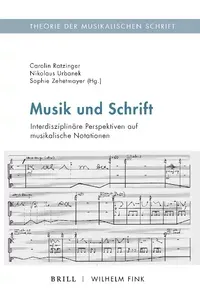
Excerpt:
ItS:
(...)
''Postludium' for mixed choir (1986) in motion is part of a series that I called "Augenmusiken"; ...At that time I made a distinction between procedures that are based solely on sound, I called them 'Hörlustmusiken', and procedures that are based solely on the written image. Postludium aus Vergessenem emerged from the appearance of the score of a small, well-known Bach prelude, or more precisely: from a recoding of this typeface according to certain rules I had established: all consecutive notes had to be connected with a pencil so that in this case out of a minor third downwards and upwards again a triangle was created optically . In the next step, this triangle had to be completely filled with sound. In Bach's case it was just three consecutive notes, in my case it became a polyphonic dense quarter-tone cluster. This kind of 'recoding' developed an incredible momentum of its own and led to results that I would never have come up with on my own. The exciting thing was to always think about these results in terms of sound: how could an extremely polyphonic 'triangular' dense cluster, this visually coloured 'triangle', be made to sound most interesting? ... In the end, the 2 minutes of the original became a 10-minute piece for mixed choir 'in motion' plus percussion - a huge graphic score in A1 landscape format, the individual pages of which could be wonderfully displayed and read across the entire row of walls of a gallery. A 'music for the eyes'.